Most investors considering the UAE Golden Visa treat the mortgage and the visa application as two separate decisions made at different times. The mortgage comes first, because it funds the property purchase. The visa follows once the title deed is registered. But this sequential approach leaves capital on the table.
A UAE mortgage does not just finance a property. Structured correctly, it is a capital-efficiency tool that allows an investor to meet the AED 2 million residency threshold while preserving liquidity for a second objective — whether that is a citizenship programme in another jurisdiction, a portfolio position in another asset class, or a capital reserve that generates a higher return than it would locked in property equity.
The cross-pillar strategy treats the mortgage, the property purchase, and the Golden Visa application as one integrated plan rather than three sequential ones. This article explains how the pillars fit together, where the capital logic holds, and what the sequencing looks like in practice for investors using UAE bank finance for the first time.

The AED 2 Million Threshold — How Financing Changes the Equation
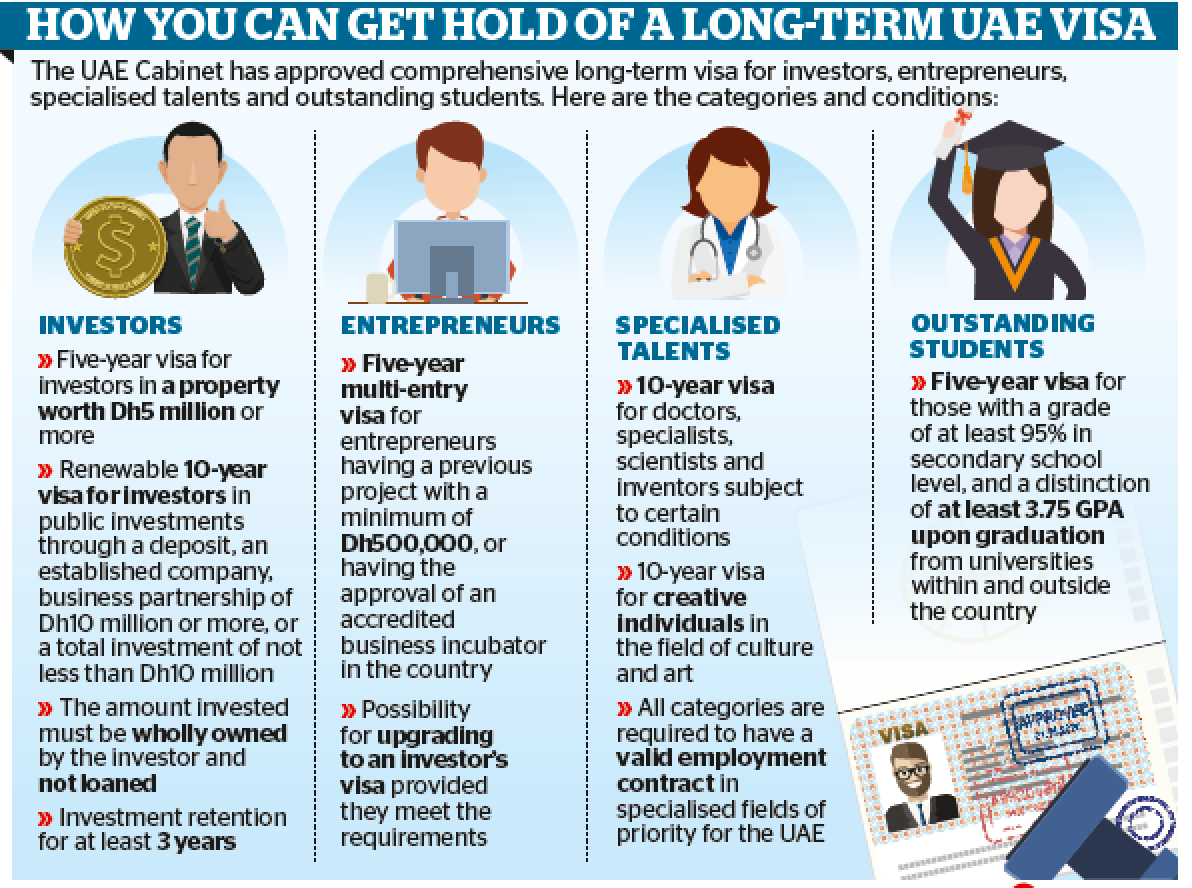
To qualify for the UAE Golden Visa through property, the investment must meet or exceed AED 2 million in assessed value. Many investors read this as a cash requirement. It is not. A financed purchase can satisfy the threshold, provided the underlying property value meets AED 2 million at the time of DLD registration — not the equity position the investor currently holds.
What the DLD and GDRFA actually check
The Dubai Land Department registers the full transaction value, including the financed portion. GDRFA, when processing the Golden Visa application, draws on the DLD title deed and the property valuation certificate — neither document reflects how much of the purchase price the investor paid upfront.
This is a meaningful distinction. An investor who purchases a property valued at AED 2.4 million with a deposit of approximately 25–30% and a bank mortgage covering the remainder has met the AED 2 million threshold via the registered transaction value, while retaining a significant portion of capital that would otherwise have been locked in the property. GDRFA does not require proof that the full purchase price was funded from personal liquidity. The title deed and a No Objection Certificate from the lending bank are the operative documents at the GDRFA stage.
One practical constraint applies: off-plan properties, which are registered via OQOOD with the Dubai Land Department rather than on a standard freehold title deed, carry a different GDRFA processing pathway. This is covered in the sequencing section below.
Off-plan vs secondary market — which route works for a financed qualification
Secondary market properties — those with an existing freehold title deed — offer the clearest path to a financed Golden Visa qualification. The title deed is issued at DLD registration, and the GDRFA application can follow once the No Objection Certificate and mortgage endorsement are documented and the DLD registration is complete.
Off-plan properties registered through OQOOD are a different case. GDRFA accepts OQOOD-registered off-plan properties for the Golden Visa, but the qualifying threshold is typically assessed against the paid-up portion of the property value rather than the total registered off-plan value. For an investor using bank finance to minimise equity deployed upfront, this means the paid equity into the off-plan project must reach the qualifying threshold — a longer path than the secondary market route.
For investors using bank finance specifically to preserve capital while qualifying for the Golden Visa, secondary market properties with a registered DLD title deed are the more direct route. Off-plan finance works but requires careful tracking of the equity milestone and an additional verification step with GDRFA during the application.
The Liquidity Case — Where the Freed Capital Goes
The financial case for using a mortgage in a Golden Visa strategy extends well beyond affordability. Even investors who could purchase outright often find that the mortgage creates a structural advantage: it converts a large illiquid position into a smaller, actively managed one. The question then becomes what to do with the freed capital — and whether the return on that deployed capital justifies the cost of the mortgage.
Capital efficiency and the leverage calculation
An all-cash purchase of an AED 2.4 million property locks up AED 2.4 million in a single illiquid asset. A financed purchase — using a bank mortgage at a loan-to-value ratio of approximately 60–75%, depending on the lending bank’s non-resident policy and the borrower’s financial profile — requires a significantly smaller equity position upfront. The retained capital can then be deployed into other assets, income-generating instruments, or a second residency or citizenship programme.
The strategy holds when the return on the deployed capital exceeds the cost of the mortgage on a risk-adjusted basis. At AED mortgage rates that have generally ranged between approximately 4–5.5% per annum in the current lending environment, and with Dubai residential yields commonly in the 5–7% range for well-located secondary market properties, the rental income from the UAE asset can offset a meaningful portion of the financing cost — leaving the deployed capital as the net beneficiary of the structure.
Rental income as a natural offset to the mortgage cost
Many properties in the AED 2–3 million bracket in established Dubai locations generate gross rental yields in the 5–7% range. At AED 2.4 million, that translates to AED 120,000–168,000 per year in rental income before service charges and management costs — sufficient in many cases to cover a significant portion of the annual mortgage repayment. The investor holds the property as a yield-generating qualifying asset while the freed equity works separately toward the second objective.
Funding a second residency or citizenship programme
For investors pursuing a citizenship-by-investment programme alongside the UAE Golden Visa — whether that is Malta, a Caribbean programme, or a European fund-route — the freed capital from a UAE mortgage can become the investment vehicle for the second programme. The golden visa programmes available across different jurisdictions have varying capital requirements, but many fall within the range that a structured UAE mortgage strategy can release from the primary property position.
The structure in practice: the UAE mortgage covers the AED 2 million property position, qualifying the investor for UAE residency. The freed equity — capital that would otherwise have been fully absorbed by the UAE property purchase — becomes the fund investment or capital contribution required for the second programme. The UAE residency and the second programme become two outputs of one capital allocation decision, rather than two competing demands on the investor’s liquidity.
Coordinating the timelines of both processes — mortgage approval, DLD registration, Golden Visa processing, and the second programme’s due diligence — requires detailed advance planning. The document demands of each process overlap in ways that create compounded friction if each is managed independently by separate advisors.
Currency positioning and the AED advantage
The UAE dirham is pegged to the US dollar at AED 3.67. For investors from markets with meaningful currency volatility, a UAE-based mortgage provides indirect dollar exposure on both the asset and the financing liability. The property value is denominated in AED, the mortgage repayment is in AED, and any rental income collected is in AED — all linked to the dollar peg.
For an investor whose home currency has weakened against the dollar over recent years, the AED-denominated asset and mortgage represent a form of structural hedging. The cost of servicing the mortgage in AED remains constant in dollar terms, while any appreciation in the home currency makes the repayment cheaper in local terms. This is a secondary consideration rather than the primary argument for the mortgage strategy, but it is a structural feature that rewards investors who think in multi-currency terms.

Sequencing the Application — Mortgage, DLD, and GDRFA
Investors who approach the cross-pillar strategy without a clear sequencing plan tend to encounter friction at the wrong moment — when a bank NOC delays DLD registration, or when a GDRFA file is opened with documentation that reflects a property that is not yet on a registered title deed. The sequence below applies to secondary market purchases using bank finance, which is the most direct structure for a financed Golden Visa qualification.
Mortgage pre-approval before the purchase agreement
Mortgage pre-approval should be secured before the purchase agreement is signed. This is standard advice that is routinely missed by investors approaching the UAE property market without prior experience of the local lending process. The consequence of omitting it is a purchase timeline that extends by four to eight weeks while the bank processes the full application — long enough to lose a property in a competitive secondary market.
The pre-approval letter from the lending bank defines the maximum loan amount, the LTV applied, the rate type, and any conditions attached to the specific property type or the borrower’s profile. Once the purchase agreement is signed, the bank orders a RERA-certified valuation of the property. If the valuation comes in below the agreed purchase price, the LTV cap means the loan amount decreases and the buyer must cover the difference from their own funds. This is a common source of unexpected capital calls for buyers who planned their deposit around a specific loan quantum.
Document overlap between bank underwriting and GDRFA
The bank underwriting process and the GDRFA Golden Visa application share a significant portion of their documentation requirements. A structured preparation approach consolidates these into a single document file that satisfies both processes in one pass, rather than two separate collection exercises run weeks apart.
Documents common to both processes include passport copies for all applicants and family members to be sponsored, proof of source of funds for the down payment, property-related documentation including the purchase agreement and ultimately the registered title deed, and a clean financial history demonstrating the absence of adverse credit. The bank additionally requires income verification or asset statements to assess debt serviceability. GDRFA adds a medical fitness certificate and Emirates ID application at the visa processing stage — documents specific to the residency application rather than the property transaction itself.
Preparing the overlapping documents in a single consolidated phase — rather than sequentially for the bank first, then separately for GDRFA weeks later — removes two to three weeks from the total end-to-end timeline for investors who run the mortgage and visa processes in parallel from the outset.
The sequencing error investors most often make
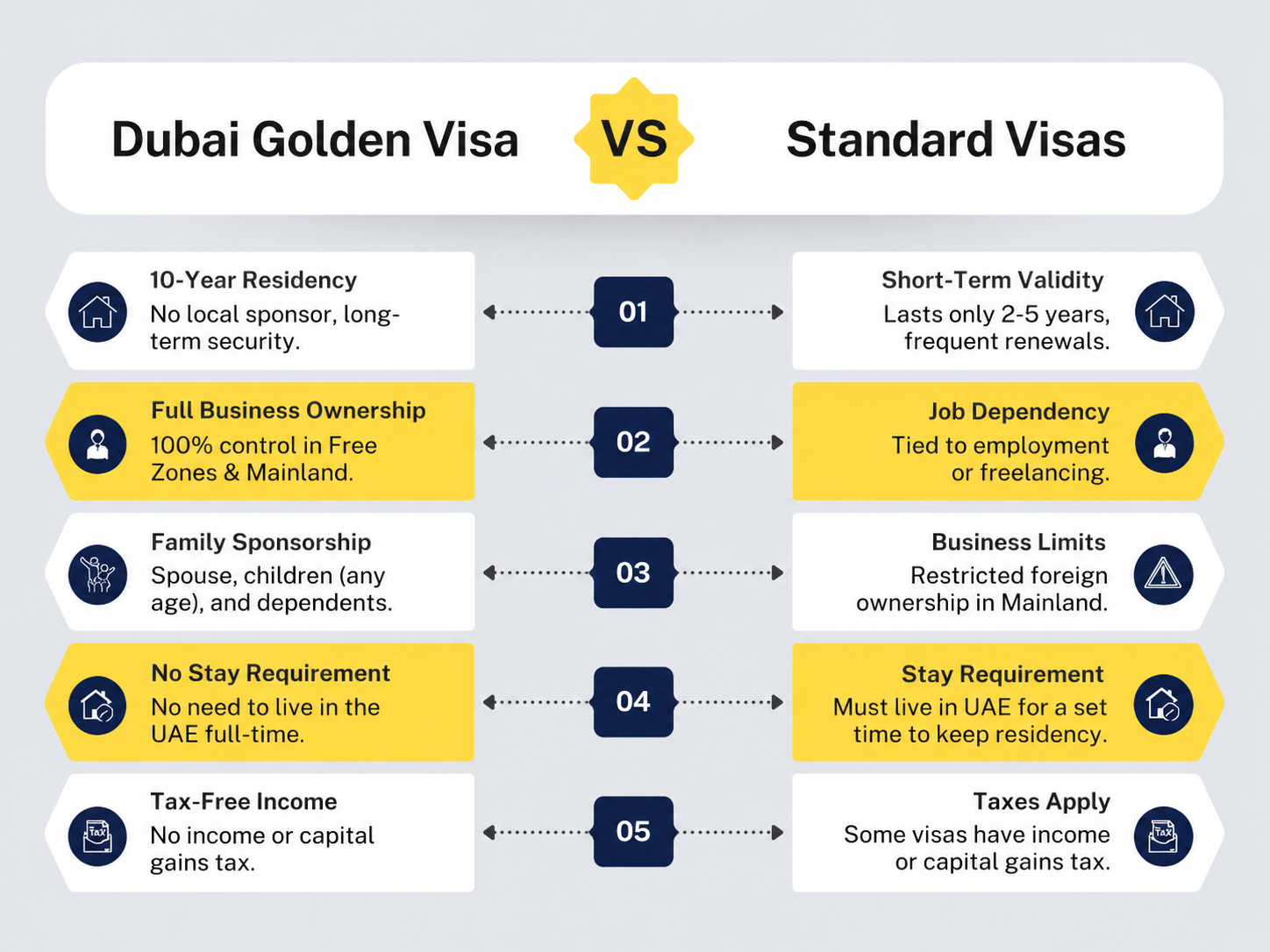
The most common sequencing error is attempting to open the Dubai Golden Visa application before the DLD title deed is issued. GDRFA requires a registered DLD title deed as the primary proof of qualifying property ownership for secondary market purchases. An OQOOD registration or an interim title certificate is not accepted in its place for GDRFA purposes.
For a secondary market purchase using bank finance, the title deed is issued at the DLD registration stage — which only occurs once the bank mortgage is registered simultaneously at the DLD. The bank will not release the purchase funds without the title deed registration, and the DLD will not register the sale without the simultaneous bank mortgage registration. These happen in a coordinated single transaction at the DLD office, requiring the bank’s funds to be ready and the seller’s NOC to be in place.
The practical implication is clear: GDRFA cannot be approached until DLD registration is complete, and DLD registration requires the mortgage to be fully approved and the funds ready to release. Any investor who begins the GDRFA process before the title deed is in hand will encounter a file hold at the review stage that requires the application to be restarted once the title deed is available.

Structuring the Cross-Pillar Plan
A mortgage-funded Golden Visa strategy requires five decisions to be made in sequence, with each one informing the next. These are not independent choices — they form a chain where the wrong answer at step two creates problems at step four. The practical approach is to resolve all five before the purchase agreement is signed, not after the mortgage is in place.
Five decisions that determine whether the pillars connect
First: property selection. The property must value at or above AED 2 million on an independent RERA valuation, not just on the agreed purchase price. Investors who purchase at exactly the threshold sometimes find the independent valuation comes in slightly below the agreed figure — eliminating the Golden Visa qualification. A valuation buffer above the threshold removes this risk and is worth accounting for in the property shortlisting process.
Second: mortgage structure. Fixed or variable rate, repayment or interest-only, and the term length all affect the serviceability calculation and the amount of capital released for secondary deployment. The right structure depends on what the investor plans to do with the freed capital and the income streams available to service the mortgage comfortably over the term.
Third: source of funds documentation. Both the lending bank and GDRFA require traceable proof of source for the down payment funds. Capital that flows through multiple jurisdictions, or that has a complex beneficial ownership structure, needs to be documented in advance of the underwriting process — not reactively once the bank’s compliance team requests it. This is consistently the step that causes the most delay for first-time UAE property buyers.
Visa scope, family sponsorship and the second objective
Fourth: Golden Visa scope. The investor may wish to sponsor family members on the same visa. Each family member to be sponsored under the investor’s Golden Visa requires additional GDRFA documentation and a medical fitness certificate. Establishing the full family scope at the outset prevents a second, separate GDRFA application later — with the associated costs and processing time that entails.
Fifth: the second objective. If the freed capital is intended for a citizenship programme, a fund investment, or a specific portfolio allocation, the timeline for deploying it should be mapped before the mortgage completes. Capital held uninvested while the investor deliberates on its destination carries an opportunity cost that compounds if the decision is deferred for several months after the UAE transaction closes.
When to involve a cross-pillar advisory team
Coordinating a mortgage approval, a DLD registration, a GDRFA application, and a second residency or citizenship programme simultaneously requires an advisory team that understands all four processes and the specific points at which they interact. Treating them as four separate engagements — each managed independently with its own document requests and timelines — typically results in the same documents being collected twice, sequencing errors that cost weeks, and critical interdependencies that go unmanaged until they become active problems.
How Helis structures the integrated approach
Helis International’s cross-pillar methodology treats the UAE mortgage for property investors, the Golden Visa, the Dubai property outlook, and any second residency or citizenship objective as one coordinated engagement — not four adjacent processes managed in sequence.
In practice, this means a single document preparation phase that satisfies bank underwriting, DLD requirements, and GDRFA simultaneously. It means property sourcing that screens for Golden Visa eligibility at the independent valuation stage, not after the purchase agreement is signed. And it means the second-programme timeline is mapped before the mortgage completes, so the capital released by the financing has a defined destination and a deployment date rather than sitting idle while the investor decides what to do next.
For investors running a UAE mortgage strategy for the first time, the integrated approach shortens the end-to-end timeline, reduces the risk of sequencing errors at the DLD and GDRFA stages, and ensures the capital freed by the mortgage is deployed with the same rigour applied to the primary UAE position. The mortgage and the Golden Visa are not two decisions. They are one decision with two execution tracks — and how the mortgage is structured determines what the second track has to work with from day one.