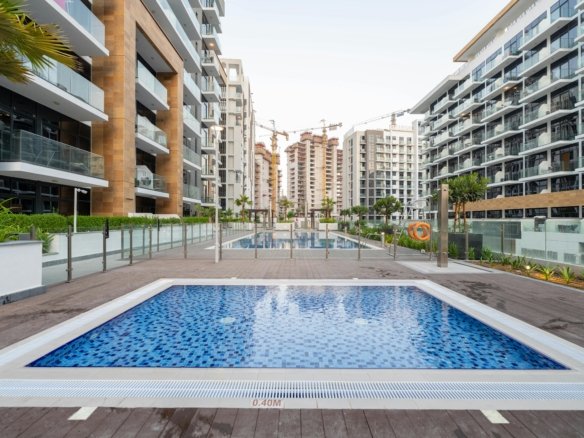
Dubai rental yield outlook 2026 is becoming a central topic for long-term investors evaluating income-focused property allocation. While capital appreciation often captures headlines, rental yield ultimately determines portfolio stability, cash flow predictability, and risk resilience.
Dubai’s property market in 2026 is supported by sustained population growth, strong corporate migration, and global capital inflows. However, yield performance is no longer uniform across segments. Investors must evaluate micro-markets, supply timing, and financing behaviour more carefully than in previous cycles.
This article examines six data-driven trends shaping Dubai rental yield outlook in 2026 and explains what disciplined long-term investors should watch closely.
Table of Contents
ToggleWhy Dubai Rental Yield Outlook 2026 Deserves Attention
Yield is the foundation of defensive property investing. In a maturing market, rental performance determines downside protection during capital volatility.
Dubai rental yield outlook 2026 is influenced by:
- Resident population growth
- Job market expansion
- Supply pipeline timing
- Mortgage rate behaviour
- Tenant affordability thresholds
Investors who monitor yield fundamentals—not just price trends—position themselves for stable long-term performance.
Dubai Rental Yield Outlook 2026: Trend 1 — Population Growth Supporting Tenant Demand
Dubai’s expanding population remains one of the strongest structural drivers of rental demand. Employment growth in finance, technology, healthcare, logistics, and global business services continues to attract professionals and families.
More residents create:
- Broader tenant pools
- Lower vacancy risk
- Stable occupancy rates
In the context of dubai rental yield outlook 2026, this demographic strength supports mid-market and family-oriented communities particularly well.
As long as net migration remains positive, tenant demand provides yield stability.
Trend 2: Supply Delivery Timing and Micro-Market Variation
Not all supply affects yield equally.
In 2026, investors must differentiate between:
- Over-supplied submarkets
- Balanced communities
- High-demand, low-delivery zones
Yield compression often occurs where supply clusters heavily in a short time frame. Conversely, communities with limited new handovers may maintain stronger rental pricing.
Dubai rental yield outlook 2026 therefore depends heavily on location-specific data, not city-wide averages.
Smart investors analyse delivery schedules before committing capital.
Trend 3: Mid-Market Yield Stability vs Luxury Compression
Luxury and mid-market segments behave differently when evaluating yield.
Mid-market typically offers:
- Higher gross yields
- Deeper tenant pools
- Lower vacancy risk
Luxury often provides:
- Lower yields
- Appreciation-driven returns
- More sensitivity to global wealth cycles
Within dubai rental yield outlook 2026, mid-market communities are expected to show stronger yield consistency, while luxury assets may experience moderate yield compression if capital values rise faster than rents.
Allocation clarity matters.
Trend 4: Interest Rates and Yield Spread Behaviour
Yield cannot be analysed without considering financing costs.
Investors monitor:
- Mortgage rate trends
- Spread between rental yield and borrowing cost
- Net cash flow margins
If mortgage costs rise significantly relative to rental yield, leveraged investors experience margin compression. If borrowing stabilises or declines, yield spread improves.
Under dubai rental yield outlook 2026, disciplined investors model net yield—not just gross headline figures.
Yield spread is the real profitability indicator.
Trend 5: Short-Term vs Long-Term Rental Strategy Divergence
Another structural change in 2026 is the growing divergence between short-term and long-term rental strategies.
Short-term rental characteristics:
- Potentially higher gross yield
- Greater management intensity
- Seasonal volatility
Long-term rental characteristics:
- Predictable occupancy
- Lower management cost
- Stable annual income
In dubai rental yield outlook 2026, professional asset management increasingly determines which strategy performs better.
Not all investors are suited to short-term rental complexity.
Trend 6: Investor Professionalisation and Asset Management Discipline
Yield is not just market-driven—it is management-driven.
Professional investors in 2026 are:
- Actively managing renewals
- Benchmarking rental pricing
- Renovating selectively to maintain competitiveness
- Monitoring tenant retention
As Dubai’s investor base matures, competition for quality tenants increases.
Within dubai rental yield outlook 2026, asset management discipline becomes a yield differentiator.
Passive ownership is becoming less competitive.
How Long-Term Investors Should Position in 2026
Based on structural trends, long-term investors should:
- Prioritise communities with sustained tenant depth
- Evaluate supply pipelines before purchase
- Model conservative vacancy assumptions
- Calculate net yield after financing
- Treat property as an income asset, not just appreciation play
Yield stability supports portfolio resilience.
Common Yield Misconceptions Investors Must Avoid
Experienced investors avoid:
- Using gross yield without expense modelling
- Assuming city-wide averages apply to every location
- Ignoring service charges and maintenance cost impact
- Overestimating short-term rental occupancy
Dubai rental yield outlook 2026 rewards realism and disciplined modelling.
Dubai rental yield outlook 2026 reflects a market where income fundamentals remain strong but increasingly segmented. Population growth, employment expansion, and tenant demand continue to support rental stability—especially in mid-market communities.
However, supply timing, interest rate spread, and asset management quality will determine individual performance outcomes.
For long-term investors, yield analysis is not optional—it is strategic. Those who evaluate data, manage assets actively, and align financing with rental performance will maintain consistent returns in 2026 and beyond.
Learn more about Real Estate at Helis International.
Chat securely on WhatsApp with HELIS International