

Not every golden visa programme offers a direct property route, and the rules governing those that do have shifted substantially since 2023. The Portugal Golden Visa programme closed its residential property route. Spain closed its programme entirely. Greece restructured its investment thresholds by zone. For investors weighing real estate as the qualifying mechanism, the differences between what is available today versus two years ago are significant.
This guide covers which programmes still permit direct property investment, what thresholds and property types qualify, the financial realities around leverage and yield that promotional material rarely addresses, and the structural mistakes investors make before proper legal and financial review. For a comparative overview of all active golden visa programmes and their full investment route options, see our golden visa programmes.
| Programme | Property Route | Threshold | Status |
|---|---|---|---|
| UAE Golden Visa | Yes | AED 2M freehold (per title deed) | Active |
| Greece | Yes | €250k (low-density) / €800k (Athens, Mykonos, Santorini) | Active |
| Hungary | No (Fund Route) | €250,000 regulated real estate fund | Active |
| Malta | Partial | Property purchase or lease plus government contribution | Active |
| Portugal | No | Fund route only (residential property route closed October 2023) | Residential closed |
| Spain | Closed | N/A | Programme closed 2024 |
Property Route vs Fund Route: Which Programmes Still Allow Direct Real Estate
Where Property Still Qualifies Directly
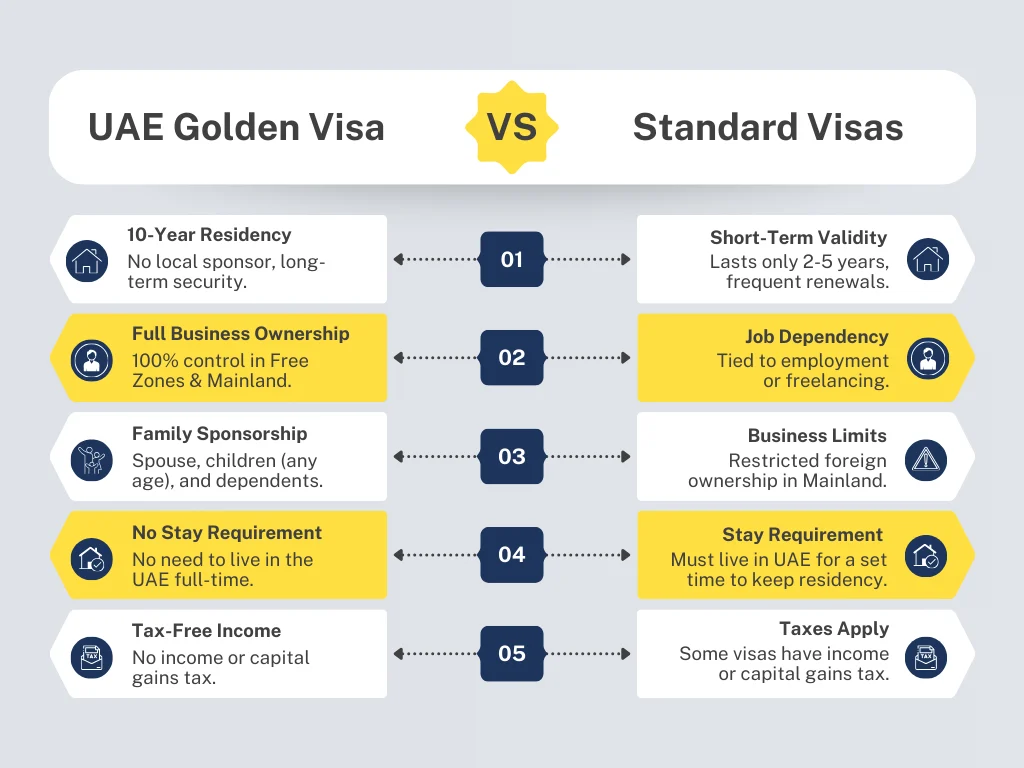
The UAE and Greece are the two major programmes where a direct residential or commercial property purchase still qualifies as the sole investment. In the UAE, a freehold property with a DLD-registered value of AED 2 million or above — whether purchased outright, financed through a mortgage, or acquired off-plan — qualifies for the 10-year Golden Visa under the current framework. Greece operates a tiered threshold system based on property location: properties in low-density mainland areas qualify at €250,000, while Athens, Thessaloniki, Mykonos, Santorini, and other high-demand zones now require a minimum €800,000 investment following the 2023 restructuring.
Both programmes have genuinely low physical presence requirements. Greece has no mandatory minimum stay to maintain residency — the five-year renewable permit renews provided the property is still held. The UAE Golden Visa similarly imposes no annual stay requirement, making both programmes compatible with investors who are not relocating but want legal residency and the access rights that come with it.


Where Property No Longer Works
Portugal closed its residential property route in October 2023 under legislative pressure linked to domestic housing affordability. The closure applied to direct residential property purchases in all Portuguese territories. Fund routes remain fully active — CMVM-regulated investment funds with a minimum €500,000 commitment are the primary qualifying mechanism. Investors drawn to Portugal for its NHR/IFICI tax regime and the citizenship pathway at five years can still access the programme, but the investment must now go through a qualifying fund structure, not directly into property.
Spain closed its golden visa programme to new applicants in April 2024. Investors with applications already in progress were given a transitional window, but no new property-route applications have been accepted since. The closure followed sustained political pressure around housing costs in Barcelona and Madrid, where qualifying properties had been concentrated.
Where Property Was Never the Primary Route
Malta’s Permanent Residence Programme requires a property component — a purchase of €375,000 or above (€300,000 in the south or Gozo), or a rental commitment of €14,000 per year in qualifying areas — but property alone does not qualify. The programme also requires a government contribution of €98,000 (purchasing) or €68,000 (renting) and a €2,000 philanthropic donation to a registered Maltese NGO. All three elements are mandatory; the property element is one part of a composite requirement.
Singapore’s Global Investor Programme has no property component. The qualifying investment must go into a Singapore-operating business, a Singapore-based family office with AUM requirements, or a GIP-approved fund. Hungary’s Guest Investor Programme, relaunched in 2024, routes qualification through HFSA-regulated real estate investment funds with a minimum €250,000 commitment — direct property purchases do not qualify under the current framework. Caribbean citizenship programmes (St Kitts, Dominica, Grenada, Antigua) permit real estate routes through approved developments, but these are citizenship-by-investment programmes operating under entirely different legal frameworks from residency golden visa programmes.
Investment Thresholds by Programme
UAE: AED 2M Freehold Minimum
The UAE Golden Visa property threshold sits at AED 2 million in DLD-registered property value. Recent administrative guidance and processing practice indicate for ready properties with a mortgage, the full DLD-registered value of the property counts toward the threshold — not just the paid-up equity portion. This reversed the earlier interpretation that required AED 2 million in net equity. Off-plan properties still use the paid-amount test: the investor must have paid at least AED 2 million to the developer through Oqood registration at the time of application.
The distinction between the two-year investor visa (AED 750,000 threshold) and the 10-year Golden Visa (AED 2 million threshold) is substantive, not just a matter of tenure length. The UAE residency by property investment framework covers both tiers, but the 10-year Golden Visa additionally offers family sponsorship for dependants up to age 25, no UAE national sponsor requirement, and the right to sponsor domestic staff without restrictions that apply to the investor visa tier. For investors whose goal is long-term planning rather than short-term access, the cost differential between AED 750,000 and AED 2 million is generally justified by the structural advantages of the Golden Visa tier.
For the GDRFA application process and how the GDRFA-DLD integrated platform and recent improvements to processing timelines, the Dubai Golden Visa guide covers the procedural detail in full.

Why Multiple Properties Cannot Be Pooled Toward AED 2M
A common misunderstanding is that investors can pool multiple freehold properties to reach the AED 2M threshold. This is not how ICP and GDRFA apply the rule. Current processing practice generally requires a single qualifying property title to independently satisfy the AED 2M threshold. Investors intending to combine multiple lower-value assets should obtain written confirmation before proceeding. A combined portfolio consisting of one unit at AED 1.3M and an off-plan property with AED 700K paid does not qualify. Neither property individually crosses the threshold, and GDRFA does not accept aggregated portfolio value as a substitute for a single qualifying title.
Each property submitted for a Golden Visa application must be separately titled as freehold with DLD, with a registered value of AED 2M or above on that single title deed. Off-plan properties use the paid-amount test: the investor must have paid at least AED 2M to the developer, evidenced through current Oqood registration. Leasehold interests do not qualify regardless of value. Investors who plan to reach the threshold across multiple smaller transactions should seek qualified legal advice before committing capital, as the qualification framework does not support that approach.
Greece: €250K vs €800K Zones
Greece’s property threshold restructuring in mid-2023 created a two-tier system that requires investors to verify location carefully before proceeding. The €250,000 threshold applies to islands with populations under 3,100 and most mainland regions outside designated high-demand zones. The €800,000 threshold applies to Athens, Thessaloniki, Mykonos, Santorini, and other high-demand island municipalities.
The practical implication is that investors targeting €250,000-threshold properties need to work from the current designated zone list rather than making assumptions from property location names alone — zone boundaries are defined by municipal registry, not by proximity to urban centres. Properties can straddle zone boundaries at the municipal level, and some areas that appear rural in character fall within the €800,000 threshold due to their administrative municipality classification. The citizenship pathway in Greece requires seven years of legal residency, making it a longer pathway than Portugal’s five years but still considerably shorter than most naturalisation routes. Zone thresholds, property eligibility, transaction costs, and the Airbnb restrictions are covered in full in the Greece Golden Visa property investment guide.

Malta: Property Plus Contribution Model
Malta’s Permanent Residence Programme grants permanent residency rather than a time-limited visa — once granted, it does not expire provided the investor maintains the qualifying property and pays the annual administration fee. The property threshold is €375,000 in mainland Malta or €300,000 in the south of Malta or Gozo, with the alternative of a €14,000 annual rental commitment in a qualifying property. The government contribution (€98,000 purchasing, €68,000 renting) and the philanthropic donation (€2,000) are payable at the time of application and are non-refundable regardless of outcome. The total cost of entry — property plus contributions plus professional fees — typically runs €150,000–200,000 in upfront cash beyond the property purchase price itself.
What Property Actually Qualifies
Freehold vs Leasehold: Why Tenure Matters
In the UAE, only freehold properties in designated freehold zones qualify for Golden Visa purposes. The distinction is enforced at the DLD title deed level: a standard freehold title deed is required. Leasehold arrangements, Ejari tenancy registrations, and usufruct structures do not qualify regardless of the value involved. Dubai has 74 designated freehold zones covering the majority of established and new residential developments. Abu Dhabi’s Investment Zones cover the equivalent freehold areas. Properties in non-freehold areas — including some older residential areas and government housing — cannot be used for Golden Visa qualification even if they are occupied and owned for decades.
In Greece, the property must be owned outright and registered with the relevant land registry or cadastre. Leasehold, time-share, and fractional ownership arrangements do not qualify. The investor must be the registered sole or joint owner — joint ownership with a non-qualifying investor at the full threshold value per individual owner is an option some families use for dual applications.
Off-Plan Properties and the Paid-Amount Test
For off-plan purchases in the UAE, the qualifying test at the time of Golden Visa application is the amount actually paid to the developer and registered through Oqood — the DLD’s off-plan registration system. A property with a total sale price of AED 3 million does not automatically qualify if only AED 1.4 million has been paid at point of application. The investor needs to demonstrate AED 2 million or more in paid and registered instalments to meet the threshold.
Developers and investors sometimes structure payment plans specifically to accelerate the AED 2 million paid-amount milestone when the buyer’s priority is early visa qualification. Oqood registration timestamps provide the official record for DLD purposes. Once the property completes and a standard title deed is issued, the full property value replaces the paid-amount test — but for the period between purchase and handover, only what has been paid and Oqood-registered counts.
What Gets Rejected
The following property configurations have been rejected or are structurally non-qualifying in the UAE framework. Properties in non-freehold zones or held under leasehold title do not qualify. Shared ownership structures where the individual investor’s DLD-registered share falls below AED 2 million are rejected even if the combined property value exceeds the threshold — each applicant must individually meet the threshold through their own registered interest. Hotel apartments registered under a hospitality licence rather than a standard residential DLD title deed may not qualify; some branded residence and hotel apartment units are registered as standard residential freehold (and do qualify), but this must be confirmed against the DLD title deed classification, not the developer’s marketing materials.
Commercial properties — retail units, warehouses, offices — registered with standard DLD commercial title deeds are eligible, but the application process differs slightly and involves additional verification. Investors using commercial properties for qualifying investment should seek confirmation from GDRFA on current application pathways before proceeding.

Leverage, Yield and the Financial Reality
Can You Mortgage a Golden Visa Property?
The UAE is, in practical terms, the only major active golden visa programme where leveraged property qualifies. Non-resident buyers typically access 60–65% LTV from UAE-licensed banks under current CBUAE guidelines — meaning a 35–40% down payment. On AED 2 million, that equates to approximately AED 700,000–800,000 in equity, with the remainder financed. Total cash required at completion — including DLD transfer fees (4%), agency fees (approximately 2%), and mortgage registration fees — typically runs AED 870,000–980,000 on a AED 2 million property at 60% LTV. The mortgage does not disqualify the property; since the February 2026 DLD framework update, the full registered property value qualifies regardless of how much is financed.
In Greece, Portugal’s fund route, Malta, and the Caribbean citizenship programmes, the full threshold investment must be funded from the investor’s own resources. Leveraged purchases do not qualify, and some programmes explicitly require a bank confirmation that the funds originated from sources outside the host country. This makes the UAE property route structurally distinct for investors who want to optimise capital deployment — the mortgage effectively reduces the capital tied up in the qualifying asset while the property value still meets the threshold.
Gross vs Net Yield: What the Threshold Actually Costs
Gross rental yields on qualifying UAE property (AED 2M and above) in established Dubai neighbourhoods currently run at approximately 5–7% based on transaction data and listed rental rates. Net yield after service charges (AED 15,000–40,000 per year depending on development), property management fees (typically 5–8% of rent), vacancy allowance, and maintenance provision typically settles at 3.5–5%. On AED 2 million, that represents AED 70,000–100,000 per year in net income — a meaningful return on a residency investment, particularly when compared with European programmes where the property’s primary purpose is qualification rather than yield generation.
Greece’s €250,000-threshold properties are typically in lower-demand areas where yield is limited and rental liquidity is thin. The financial case for Greece is residency access and a citizenship pathway, not property income. Athens and island properties at €800,000 and above compete in a more active rental market — tourist rental on major islands can generate strong summer yields, though year-round rental income is more modest. Investors should model both scenarios and account for local property management costs, which are meaningfully higher for short-term holiday rentals.
Rental Income During the Holding Period
UAE Golden Visa property can be rented out during the holding period without restriction. GDRFA and ICP assess qualification solely on the AED 2M DLD-registered value — occupancy status is irrelevant to visa standing. Investors are not required to use the property as a primary residence, and generating rental income does not affect renewal eligibility.
If the property is financed through a mortgage, the bank’s tenancy conditions apply separately. Most UAE-licensed lenders permit rental of mortgaged properties provided the tenancy agreement is registered via Ejari and the lender is notified. Short-term rental in Dubai additionally requires a DTCM permit; investors using holiday-let models should confirm permit eligibility for the specific unit before purchase. At renewal, the qualifying condition is continued ownership at or above AED 2M — not how the property has been used in the intervening period.
For lender selection, income documentation and approval sequencing for UAE investment properties, see our UAE mortgage for property investors guide.
Developer Risk and Exit Liquidity
Off-plan properties in the UAE carry delivery risk proportional to the developer’s track record, project capitalisation, and RERA compliance. Investors using the property route for Golden Visa qualification should verify the developer is registered with RERA, that the specific project has an escrow account compliant with Dubai Law No. 8 of 2007, and that there is a verifiable record of previous project completions. Properties from master developers — Emaar, Aldar, Meraas, and a small number of established mid-tier developers — carry materially lower delivery risk than newer entrants or smaller launches. Payment plan structures from off-plan developers can be financially attractive but should never obscure the underlying delivery risk assessment.
Exit liquidity in established Dubai freehold zones is generally adequate for investors who need to sell within a 2–5 year horizon. Secondary market transaction volumes in Business Bay, Downtown, Dubai Marina, and comparable established zones support resale without requiring deep discounts. Less-established zones and off-plan projects from smaller developers carry wider bid-ask spreads and longer time-to-sell periods. The property qualification for a Golden Visa creates a minimum hold period in practice — investors who sell the qualifying property forfeit their Golden Visa status unless they replace it with another qualifying asset before expiry.
Common Mistakes on the Property Route
Buying Below Threshold After Fees
DLD transfer fees (4%) in Dubai are paid by the buyer at the point of transfer and are not counted toward the AED 2 million threshold — the threshold is based on the DLD-registered purchase price, not the total cash outlay including fees. An investor purchasing at exactly AED 2 million meets the threshold even though total closing costs run to AED 2.14–2.16 million. However, investors who negotiate a purchase price of AED 1.95 million and attempt to supplement with another asset do not qualify through portfolio bundling — each qualifying property must individually meet the AED 2 million threshold through its own registered value.
In Greece, the same logic applies: the €250,000 or €800,000 threshold refers to the registered property purchase price. Legal fees, notary costs, and transfer tax are paid on top and do not count toward the threshold. Some investors have encountered issues where the registered value on the purchase contract is lower than the agreed price due to historical Greek practice of under-declaring property values — this creates both a legal risk and a potential threshold shortfall.
Choosing Non-Qualifying Property Types
In the UAE, the most common source of non-qualification at the title deed level is hotel apartment and serviced apartment units that are registered under a hospitality licence classification rather than a standard residential or commercial DLD title. Some branded residence products — where the developer has partnered with a hotel operator for management services — are registered as standard residential freehold and qualify without issue. Others are registered under the hospitality classification and do not qualify. The test is the DLD title deed document, not the developer’s branding, the management arrangement, or whether the unit resembles a standard apartment. This distinction should be confirmed in writing from the developer and verified against DLD records before any purchase for visa qualification purposes.
The Tax Residency Consequence
Holding a UAE Golden Visa through a qualifying property purchase does not automatically establish UAE tax residency. UAE tax residency is governed by the UAE Cabinet Resolution on Determining Tax Domicile, which requires the investor to meet day-count criteria: either 183 days or more in the UAE in the relevant tax year, or 90 or more days in the UAE with additional qualifying connections. An investor who holds a UAE Golden Visa but spends fewer than 90 days per year in the country will not meet the UAE tax residency threshold — their primary tax residency will remain wherever they are effectively domiciled, and holding a UAE visa does not override that.
This is consistently one of the most misunderstood aspects of the property-route Golden Visa. Investors who acquire UAE property for visa qualification and then continue living primarily in India, the UK, or elsewhere remain tax resident in their home jurisdiction. The UAE Golden Visa facilitates entry, residency rights, and banking access — it does not automatically rebase tax domicile. For the full framework on how legal residency and tax residency interact across programmes, see our guide on residency vs citizenship by investment.
Selling a Golden Visa Property: Hold Period and Exit
The UAE Golden Visa is tied to continued ownership of the qualifying property. Unlike some European programmes with a mandated minimum hold period, the UAE prescribes no fixed lock-in duration — but the visa lapses at natural expiry if the qualifying asset is no longer held. Investors who sell before the 10-year term ends and do not replace with equivalent qualifying property will need to exit the programme or reapply under a different qualifying category.
At renewal, investors should ensure the property continues to satisfy the prevailing qualification requirements in force at the time of renewal. Properties that have appreciated provide straightforward renewal qualification. Off-plan units resold during construction — where the buyer transfers their purchase contract — do not trigger a visa issue provided the sale completes before the renewal date. Investors planning to sell and replace should time the transaction carefully to avoid any gap in qualifying ownership at the renewal checkpoint.


Join The Discussion