UAE residency by property investment (RBI) sits at the intersection of two decisions an HNW investor must evaluate separately: where to place capital, and where to hold residency. The UAE Golden Visa has consolidated both into a single qualification threshold — AED 2 million in UAE freehold property unlocks a 10-year, renewable residency permit with no minimum stay requirement and full family sponsorship. For investors simultaneously evaluating programmes in Europe and Asia, the comparison is not simply about investment size. It is about what the residency actually delivers — and at what cost in capital, processing time, and ongoing obligation.
This article benchmarks the UAE property residency route against four alternatives serving overlapping investor profiles: Greece’s tiered Golden Visa (EU Schengen access, no stay requirement), Portugal’s fund-only route (citizenship pathway, property route closed), Malta’s Permanent Residence Programme (permanent Maltese residency, no minimum stay), and Singapore’s Global Investor Programme (a business-founder track, not a passive property route). The comparison is structured for investors at the pre-commitment stage — evaluating which jurisdiction fits their mobility requirements, tax position, and capital deployment strategy.
These programmes are not interchangeable. They serve different investor objectives and carry materially different obligations. Residency-by-investment rules, investment thresholds, and citizenship timelines also change frequently; investors should verify current programme regulations with qualified immigration counsel before committing capital.
UAE Property Investment Route — The Global RBI Benchmark
The UAE Golden Visa is a federal residency instrument issued by the UAE government and applicable across all UAE Emirates. It is the reference point against which any alternative residency programme should be evaluated for investors considering a property-backed UAE residency route in a zero-income-tax jurisdiction.
Investment threshold and qualifying property types
The UAE investor residency route requires a minimum freehold holding of AED 2 million (approximately USD 545,000 at current exchange rates) in any UAE-approved freehold zone. Dubai accounts for the majority of qualifying transactions — Palm Jumeirah, Downtown Dubai, Dubai Marina, Dubai Hills Estate, Business Bay, and Jumeirah Lake Towers are the dominant clusters — but freehold zones in Abu Dhabi, Ras Al Khaimah, Sharjah and Ajman also qualify. The programme is not Dubai-exclusive, though Dubai’s freehold market depth and transaction liquidity make it the practical default for most investors.
Off-plan property qualifies provided the completed unit value meets the AED 2 million threshold and, where a mortgage is in place, the investor’s equity position does not fall below that figure. Joint ownership qualifies if each co-investor independently holds equity at or above AED 2 million. The investment must be registered in the investor’s personal name — an offshore SPV structure does not qualify. Mortgage-financed property qualifies if the paid-up component meets the threshold; the bank does not hold the visa entitlement, the investor does.
There is no restriction on the property type — residential apartments, villas, and commercial units in freehold zones all qualify, provided the registered value is AED 2 million or above. Multiple properties can be combined to meet the threshold if they are registered across approved freehold zones.
The 2-year Investor Visa — Updated April 2026 rules
UAE property residency operates on two tiers, not one. Alongside the 10-year Golden Visa, the UAE offers a 2-year property investor visa — and the April 2026 rule changes have made this lower tier significantly more accessible. Based on revised guidance introduced in April 2026, sole property owners face no minimum property value requirement. This removes the previous AED 750,000 floor and opens the 2-year visa to investors purchasing at any price point in the residential market, provided the property is fully completed and registered with the relevant land department. For joint ownership arrangements, each co-owner must hold a minimum equity of AED 400,000.
The 2-year visa applies to completed residential properties only — off-plan assets do not qualify for this route. The permit provides residency rights and allows the holder to obtain work authorisation in the UAE, and is renewable, but it does not carry the extended family sponsorship rights or the 10-year tenure certainty of the Golden Visa tier. For investors purchasing below the AED 2 million threshold, or those evaluating UAE property residency as a shorter-commitment instrument before scaling to the Golden Visa, the 2-year visa provides a lower-entry point into the UAE property residency route. The choice between the two tiers is primarily a function of investment size, family sponsorship requirements, and how long an investor wants tenure certainty without renewal.
Residency rights, family coverage and the no-stay advantage
The UAE Golden Visa issues a 10-year, renewable residency permit. The visa is not subject to the standard six-month continuous stay restriction applicable to regular UAE residency permits — the permit does not lapse due to absence. This is a material structural advantage over several competing programmes: an investor may live full-time elsewhere, maintain UAE residency for banking purposes, and return to the UAE as and when their schedule permits without the permit lapsing.
Holders can sponsor their spouse, children subject to prevailing UAE family sponsorship eligibility rules, and parents. Domestic workers may also be sponsored under the holder’s permit. The family unit travels on the same visa umbrella, without requiring separate investor-category applications for dependants.
The UAE Golden Visa does not carry a path to UAE citizenship. It is a long-term UAE investor residency instrument, not a naturalisation track. Holding UAE residency also does not automatically establish UAE tax residency — tax residency status depends on physical presence, treaty position, and the investor’s country of domicile. For investors whose planning horizon includes passport acquisition, the absence of a naturalisation route is a material consideration and the primary reason many HNW investors hold a UAE Golden Visa alongside a European second residency simultaneously, using each for a distinct purpose.
European Residency Routes in 2026 — Greece, Portugal and Malta
Europe’s residency-by-investment landscape has changed significantly since 2022. Property routes have been restructured or eliminated in the most attractive markets, processing backlogs have lengthened, and investment thresholds have increased. Investors comparing European programmes against a UAE property residency route need current data — the landscape many advisors reference is out of date.
Greece Golden Visa — Tiered thresholds and Schengen access
The Greece Golden Visa remains one of the few European residency programmes still offering a direct real estate route in 2026. The programme underwent a significant threshold restructuring in 2023–2024, creating a two-tier investment floor based on property location:
- €800,000 — Athens, Thessaloniki, Mykonos, Santorini, and islands with a registered population exceeding 3,100 residents
- €400,000 — all other regions of Greece
- €250,000 — commercial property converted to residential use (120sqm minimum applies across all categories)
At the €400,000 entry point in regional areas, Greece is one of the more capital-efficient European residency programmes — though the asset itself has limited resale liquidity compared to a Dubai or Athens property in a core zone. The €800,000 threshold in primary markets brings Greece closer to UAE entry levels when converted to AED (approximately AED 3.1 million at current rates).

Rental restriction and yield implications
There is a critical restriction on property use under the Greek Golden Visa: the qualifying asset cannot be operated as a short-term rental. Using a Greek Golden Visa property as an Airbnb or short-term let triggers a €50,000 fine and carries the risk of visa revocation. Investors expecting rental yield from the qualifying asset need to structure separately — the property serves the visa, not the yield strategy.
Greece issues a 5-year renewable residency permit. Holders may reside and travel within the Schengen Area — employment rights within individual EU member states are subject to national regulations and do not automatically transfer across all EU jurisdictions. There is no minimum annual stay requirement to renew the permit. After seven years of legal residence, Greek citizenship applications become eligible. Processing from application to permit issuance typically runs three to six months for primary market applications.

Portugal Golden Visa — Property route closed, fund investment remains
Portugal’s property route under the Golden Visa programme closed in October 2023. The option that attracted the majority of international investors for over a decade — purchasing residential real estate — is no longer available. This is a significant change that many investors and advisors are still processing incorrectly: Portugal’s Golden Visa cannot be obtained through direct property purchase as of 2024 and remains so in 2026.
What remains is a fund investment route. The minimum investment is €500,000 deployed into an approved Portuguese venture capital or private equity fund. The fund must have a minimum maturity of five years and invest at least 60% of its capital into companies with a Portuguese head office. A cultural contribution route also remains, at a lower threshold of €200,000–€250,000, for donations to Portuguese artistic or cultural initiatives.
The residency permit requires minimal physical presence — 7 days in the first year and 14 days per subsequent 2-year renewal period. The programme historically offered the fastest EU citizenship pathway, with naturalisation eligibility after 5 years of residency. However, Portugal’s nationality law was amended in 2025, extending the general naturalisation waiting period for most foreign nationals. The impact on Golden Visa holders is still being clarified by Portuguese authorities; investors considering the programme for its citizenship timeline should verify current rules with Portuguese immigration counsel before any capital commitment.
Processing timeline and backlog risk
The most significant constraint on the Portugal programme is processing time. Applications at the immigration authority AIMA (formerly SEF) have run 2–4 years from submission to first card issuance in recent years. For investors who need active residency within a defined timeline, this is a material operational risk that the UAE property residency route — with a typical 30–60 day processing period — does not carry.

Malta MPRP — Permanent Maltese residency without minimum stay
The Malta Permanent Residence Programme (MPRP) differs from both Greece and Portugal in one material respect: it confers permanent residency from the date of approval, rather than a temporary permit requiring five-year renewal. For investors who want EU-member-state status as a durable holding rather than an instrument on a renewal cycle, this is a meaningful distinction.
Under the updated July 2025 rules, the investment structure combines three components. The government contribution is €37,000, applicable whether the applicant rents or purchases qualifying property. The property requirement is:
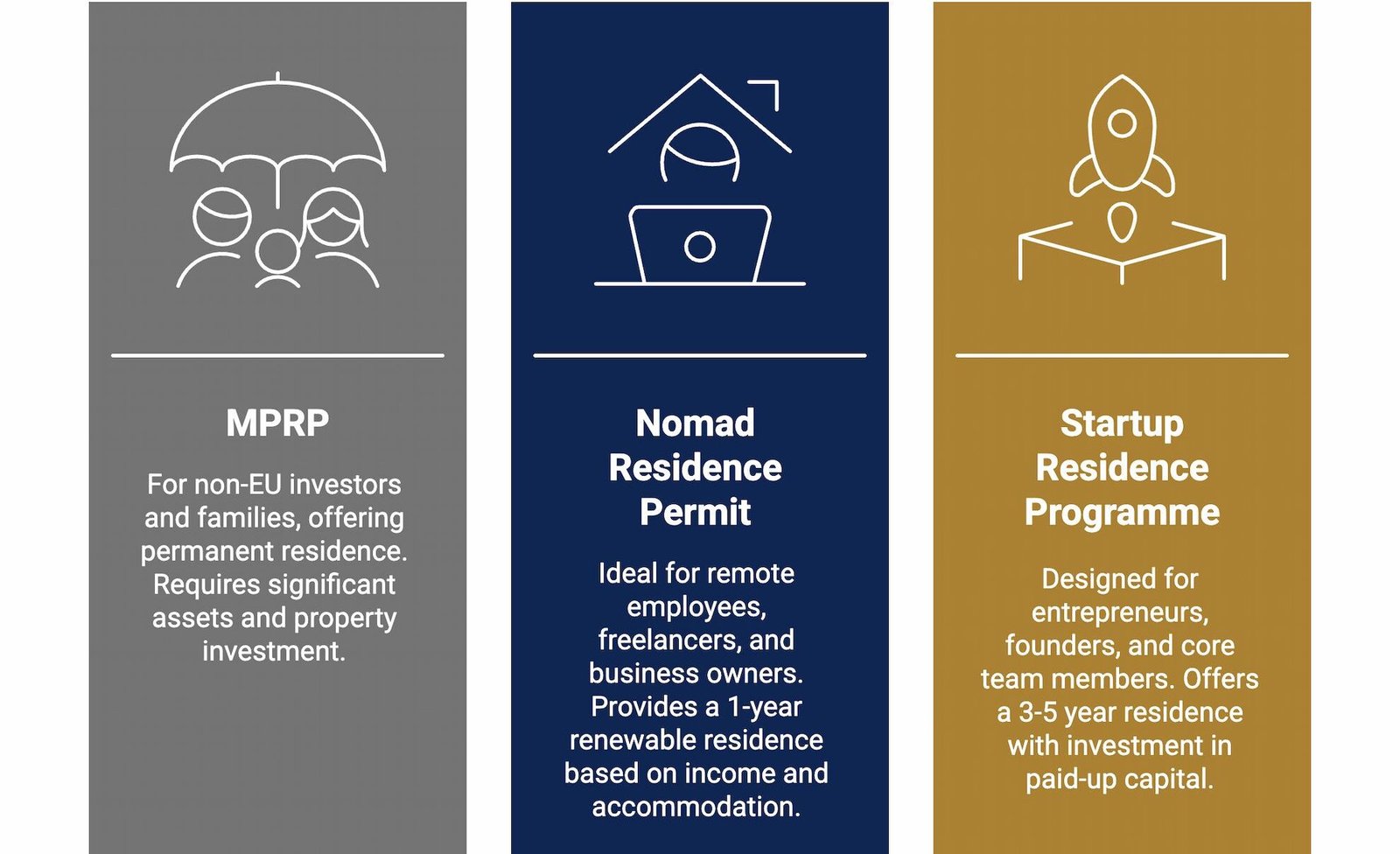
- Purchase: €375,000 minimum in central or northern Malta; €300,000 in southern Malta or Gozo
- Rental: €14,000 per year in central or northern Malta; €10,000 per year in southern Malta or Gozo
- The property or rental commitment must be maintained for a minimum of five years post-approval
Asset requirements and five-year monitoring
Applicants must demonstrate total assets of €500,000, with a minimum of €150,000 held in financial assets — equities, bonds, or bank deposits. A mandatory philanthropic donation of €2,000 to a registered Maltese non-profit completes the application. Asset holdings are monitored annually for the first five years after approval.
There is no minimum stay requirement under the MPRP. Malta is an EU member state and full Schengen member — MPRP holders can reside and travel within the EU and Schengen Area under the terms of their permanent Maltese resident status.
The MPRP does not confer a path to Maltese citizenship; that is a separate programme with distinct requirements, significantly higher investment thresholds, and a directional residency obligation. Processing time from application to approval typically runs four to six months.
Singapore GIP — The Business-Founder Track
Singapore’s Global Investor Programme (GIP) issues Permanent Residency, but it is not a passive investment route and it is not a property-backed residency instrument. Including it in a comparison with UAE residency by property investment requires clarity on what it actually is: a business relocation programme for founders and owners of scale businesses, with capital thresholds and operational obligations that have no equivalent in property-based residency markets.
Investment requirements and qualifying investor profile
The GIP offers three investment options, all structured around business principals rather than portfolio investors:
- Option A — Business investment: SGD 10 million (approximately USD 7.4 million) into a new or existing Singapore-registered business entity, with at least 30 employees of whom 10 must be new Singapore citizen hires
- Option B — Fund investment: SGD 25 million into a GIP-approved investment fund
- Option C — Single Family Office: Establish a Singapore-domiciled SFO with assets under management of at least SGD 200 million, with SGD 50 million deployed into a GIP-approved fund
Eligibility under Option A requires demonstrated entrepreneurial track record. Founders and owners must show that their business generated annual revenues of at least SGD 200 million in the most recent financial year and an average of at least SGD 200 million over the preceding three years. The GIP application fee, revised in May 2025, is SGD 20,000. Successful applicants receive a five-year renewable Singapore Permanent Resident status.
Singapore PR versus UAE residency — different instruments, different use cases
Singapore Permanent Residency via GIP and RBI are not alternatives in the practical sense — they serve fundamentally different investor objectives. A UAE Golden Visa property investment is a capital allocation decision that produces a residency outcome as a by-product. Singapore’s GIP is an operational decision about where to anchor business activity; the residency follows from that positioning.
For HNW investors evaluating both: it is common for principals to hold a UAE Golden Visa for lifestyle and tax-planning positioning, and Singapore PR through GIP for Southeast Asia business anchoring. The two instruments serve complementary functions in a multi-jurisdiction residency structure, and holding both is not uncommon for investors active across the Gulf and Asia-Pacific corridors.
What Singapore does not offer is a passive property investment route to residency. There is no Singapore equivalent of the UAE’s AED 2 million freehold threshold, Greece’s regional €400,000 entry, or Malta’s MPRP structure. Singapore’s residency-by-investment track requires active business commitment. Investors seeking a property-anchored residency in an Asian financial centre will need to evaluate other jurisdictions — the GIP is not that instrument.
Decision Framework — Matching Programme to Investor Objective
The five programmes covered in this article serve different investor objectives and cannot be evaluated on a single dimension. The table below summarises the key variables. Investment figures are approximate — always verify current exchange rates and programme rules at the point of application.
Programme comparison at a glance
| Programme | Min. Investment | Investment Type | Stay Req. | EU / Schengen | Citizenship Path | Typical Timeline |
|---|---|---|---|---|---|---|
| UAE Golden Visa (10yr) | AED 2M (~EUR 500K) | Freehold — completed or off-plan | None | No | No | 30–60 days |
| UAE Investor Visa (2yr) | No min (sole) / AED 400K (joint) — updated Apr 2026 | Completed residential only | None | No | No | 2–4 weeks |
| Greece Golden Visa | EUR 400K–800K | Real estate (zone) | None | Schengen | After 7 years | 3–6 months |
| Portugal Golden Visa | EUR 500K | Approved fund | 7 days/year | Schengen | 5+ years (subject to current law) | 2–4 years |
| Malta MPRP | EUR 37K + property | Gov. contribution + property | None | Permanent (Malta) | No (separate track) | 4–6 months |
| Singapore GIP | SGD 10M–25M | Business or fund | Active presence | No | Discretionary (extended PR) | 6–12 months |
Matching your investor profile to the right programme
Capital efficiency and no stay obligation
RBI is the most capital-efficient option for investors already deploying capital into UAE real estate. The AED 2 million threshold converts directly into a tangible property asset the investor owns outright. Processing is fast. The visa carries no continuous stay obligation. For investors for whom UAE real estate is already part of the portfolio, the residency is effectively a by-product of the investment decision. The absence of an EU passport or Schengen access is the primary limitation for investors who need European mobility.
EU Schengen access as a primary objective
Greece and Portugal are the two European programmes with no minimum annual stay that also offer Schengen mobility. Greece remains property-backed with a clear zone-based threshold structure; Portugal has moved to a fund route but retains a citizenship pathway. For investors on a 7-to-10-year citizenship planning horizon, Greece or Portugal serve that objective — a UAE investor residency route does not.
Permanent EU status without renewals
Malta’s MPRP is the only programme in this comparison that issues permanent residency from day one. Investors who want durable residency status within an EU member state without managing a 5-year renewal cycle, and who do not need Schengen access for employment purposes, should evaluate Malta alongside Greece. Malta does not offer a citizenship pathway through the MPRP itself — that is a separate track with higher investment requirements and a directional stay obligation.
Multi-programme strategy — UAE plus Europe
These programmes are not mutually exclusive. A common structure for HNW investors with Gulf-Asia-Europe mobility requirements is a UAE Golden Visa as the operational residency base, combined with a Greek or Portuguese residency on a citizenship trajectory. The UAE provides tax-planning positioning, banking access, and zero stay requirement. The European programme provides Schengen mobility and, over 5–7 years, an EU passport. The two structures serve different strategic functions within a mobility portfolio.
The right structure is the one that fits the investor’s capital position, mobility requirements, citizenship objectives, and timeline — not the one with the lowest entry threshold or the fastest citizenship route in isolation. RBI at AED 2 million is among the most capital-efficient property-linked residency instruments available globally for investors already active in UAE real estate. It does not compete directly with European routes — it serves a different function within a multi-jurisdiction residency strategy.
For a full breakdown of programme mechanics, off-plan qualification rules, and family sponsorship structure, see our UAE Golden Visa guide. For investors weighing programme combinations across jurisdictions, our residency vs citizenship advisory covers all five programmes in this comparison. For the full landscape of active programmes, see our golden visa programmes guide.
For investors structuring a UAE-plus-Europe combination, the Portugal Golden Visa is the most common complementary programme alongside UAE residency — the €500,000 fund route adds Schengen access, EU employment rights and a ten-year citizenship pathway with no relocation requirement. The Helis Investor Decision Toolkit covers the UAE, Portugal, Greece and nine other active programmes in a single comparative reference:
Once RBI approval is confirmed, the next phase is activating daily life in the UAE — registering the Emirates ID, opening bank accounts, setting up housing and utilities, and arranging schooling and healthcare for family members. Investors who want this transition managed as a single coordinated process will find a detailed breakdown in our Dubai concierge services guide, covering the setup sequence from Golden Visa approval through to operational residency.