The UAE Golden Visa is a 10-year renewable residency programme that allows foreign nationals to establish long-term legal status in the UAE through investment, property ownership, or professional qualification — without employer sponsorship, without the six-month continuous stay restriction applied to standard UAE residency visas, and with full family sponsorship rights. For HNW investors deploying capital into UAE real estate, the Golden Visa converts a financial transaction into a durable legal status: a decade-long residency platform in one of the world’s most strategically positioned jurisdictions, held independently of any employer or business relationship.
This UAE Golden Visa guide covers the property-linked qualification route in detail — the AED 2 million threshold, what qualifies and what does not, the processing timeline and government fees, what the visa actually provides in practical terms, and how it fits within a broader residency or citizenship structure for investors building multi-jurisdictional mobility. It is written for investors evaluating the Golden Visa as part of a real estate entry decision, not as a standalone immigration product. For a cross-programme comparison of qualifying thresholds and property route conditions across UAE, Portugal and Greece, see the golden visa property investment rules guide.
For a consolidated reference covering qualification routes, government fees, visa comparison tables, family sponsorship rules and a full document checklist, download the free investor handbook below.
Qualification — The AED 2 Million Property Route
What Qualifies and What Does Not
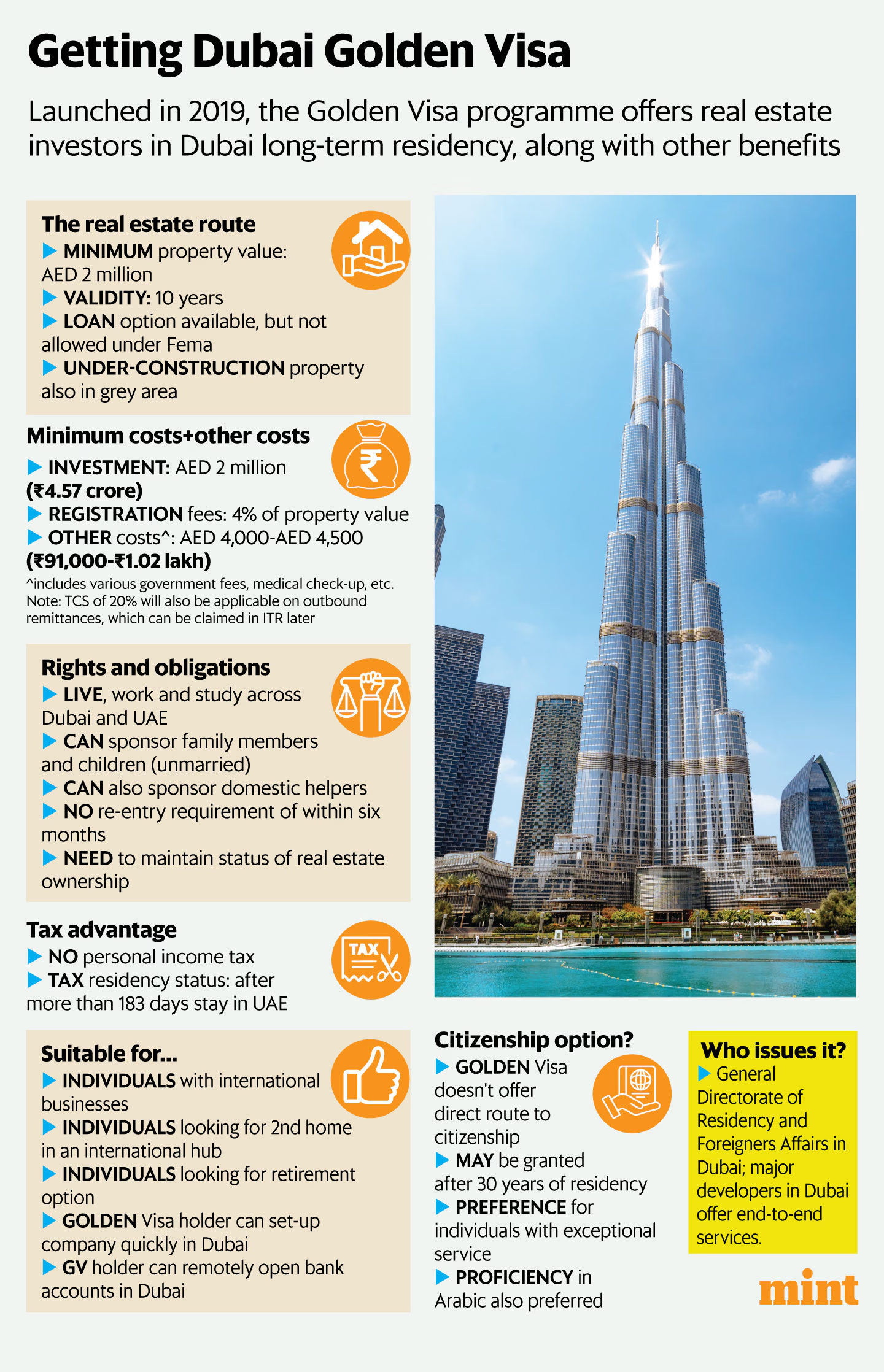
Property purchases at or above AED 2 million in the buyer’s own name — not through a corporate structure — in UAE freehold designated zones qualify the buyer for the Golden Visa. The AED 2 million threshold is assessed on the property value at the point of title deed registration with the Dubai Land Department, confirmed by an independent valuation. The purchase price in the sale and purchase agreement is used as the primary reference; DLD valuation may differ marginally.
Key qualification conditions: mortgaged properties qualify under a rule change effective February 2026. The previous requirement that the paid-up equity portion reach AED 2 million has been removed. Only the DLD-certified total property value needs to meet the AED 2 million threshold, regardless of mortgage balance or how much has been paid toward the property. A property purchased at AED 2.5 million with AED 500,000 paid up now qualifies, provided the DLD valuation confirms a total value at or above AED 2 million. Joint ownership qualifies each co-owner individually if each person’s ownership share equals or exceeds AED 2 million — a combined purchase of AED 4 million between two individuals at equal shares qualifies both; a combined AED 2 million at AED 1 million each qualifies neither. Investors financing through a mortgage — where lender selection and income documentation require a specialist pre-application approach — can review the advisory framework in the UAE mortgage for property investors guide.

Multiple Properties and Portfolio Qualification
Investors who own multiple UAE properties can aggregate their holdings for Golden Visa purposes, provided the total portfolio value in the individual’s own name equals or exceeds AED 2 million. A portfolio of two properties — one at AED 1.2 million and one at AED 900,000, both fully paid and held in the investor’s personal name — totals AED 2.1 million and qualifies. The aggregation approach is formally available under the Golden Visa regulations but requires an affection certificate from DLD confirming the combined ownership value. This is a relevant structuring option for investors who have built a portfolio below the single-unit AED 2 million threshold.
The investment case for targeting AED 2 million as a portfolio threshold — rather than purchasing a single higher-value unit — is worth evaluating explicitly. Two mid-market units, each at AED 1 million, may produce higher combined yield than one premium unit at AED 2 million, while achieving the same Golden Visa qualification. The trade-off involves management complexity (two tenancies, two service charge obligations) against yield optimisation and the residency benefit. For investors whose primary objective is yield with residency as a secondary benefit, the portfolio approach often produces better return on the capital deployed.
Off-Plan Property and Qualification Timing
Off-plan properties from approved local developers do qualify for the Golden Visa, but the application timing differs from completed units. For off-plan purchases, full Golden Visa issuance typically follows project completion and title deed registration — when the full AED 2 million has been paid to the developer and the unit is registered at DLD. Developers and GDRFA periodically offer partial-payment qualification structures or escrow-linked eligibility; verify the current position with the project developer and GDRFA before purchase. Prior to completion, the buyer holds an Oqood (interim registration certificate), which does not support a Golden Visa application. The Oqood establishes ownership rights during construction but is not a substitute for the title deed required by GDRFA. Note that the February 2026 rule change — which allows mortgaged ready properties to qualify on DLD-certified total registered value rather than paid-up equity — applies specifically to ready properties with a DLD title deed. Off-plan qualification continues to be assessed on the cumulative amount paid to the developer, as DLD does not issue a title deed until handover.
Investors purchasing off-plan and targeting a Golden Visa on a specific timeline should factor the handover date into their planning. A unit with a 2027 handover date does not produce a Golden Visa until 2027 at the earliest — regardless of how much has been paid during construction. For investors for whom the residency benefit has time-sensitive practical value (school enrollment, banking access, business operations), a completed unit delivers the Golden Visa on a known four-to-six-week timeline, without construction and handover risk.
When an off-plan unit reaches handover, the qualification and submission sequence runs as follows: the developer completes the Oqood-to-title-deed conversion at DLD (typically one to three weeks post-handover); the buyer then receives the DLD title deed and, where a mortgage is in place, the mortgage registration certificate. With these documents confirmed, the GDRFA Golden Visa application is submitted through the ICA Residency portal or via a GDRFA-registered typing centre. GDRFA processing runs four to six weeks from complete document submission. Buyers who purchased through the GDRFA–DLD unified platform (operational from April 2026) benefit from integrated data transfer — DLD registration data flows directly to GDRFA, reducing the document pack required at submission. The Oqood remains on file as the ownership record during construction but plays no direct role in the GDRFA submission itself; it is the DLD title deed that triggers eligibility.
What the UAE Golden Visa Actually Provides

Residency Rights and Practical Benefits
The UAE Golden Visa provides a 10-year renewable UAE residency permit — an Emirates ID and a residency stamp in the holder’s passport — with no minimum annual stay requirement. The absence of a minimum stay requirement is the single most important practical characteristic: the holder maintains valid UAE residency without being required to spend a fixed number of days per year in the UAE. Standard UAE employment visas require at least one entry every six months to avoid lapse; the Golden Visa has no such requirement, allowing the holder to maintain UAE residency while spending most of their time elsewhere.
Practical benefits that flow from Golden Visa residency: UAE banking relationship establishment (without which many financial services in the UAE are inaccessible to non-residents), access to UAE health insurance, school enrollment for children in UAE schools, and the ability to sponsor domestic staff under the UAE residency framework. The visa also provides an extended grace period after expiry to facilitate renewal, without the risk of overstay penalties that apply to standard visit visas. For investors who intend to use the UAE as an operational base — spending significant time there for business, family, or lifestyle reasons — the Golden Visa provides the legal infrastructure that makes that base functional rather than merely permitted.
Family Sponsorship
The Golden Visa holder can sponsor spouse, children under 18 (and unmarried daughters of any age), and domestic staff for UAE residency under the same 10-year permit framework. Each family member’s visa is processed separately — the primary applicant is processed first, then dependants are added. Sponsored family members receive the same 10-year term as the primary holder, renewable concurrently. Adult sons over 18 are not eligible for sponsorship under the standard family route; they require their own qualification — either employment, education, or their own investment.
For families relocating to or establishing a UAE base, the family sponsorship scope covers the primary household unit comprehensively. The practical considerations are school enrollment timing — UAE schools operate on a September intake cycle, and the visa processing timeline of four to six weeks means families targeting a September enrollment should initiate the Golden Visa process no later than June — and health insurance, which is mandatory for UAE residents and must be arranged as part of the residency establishment process.

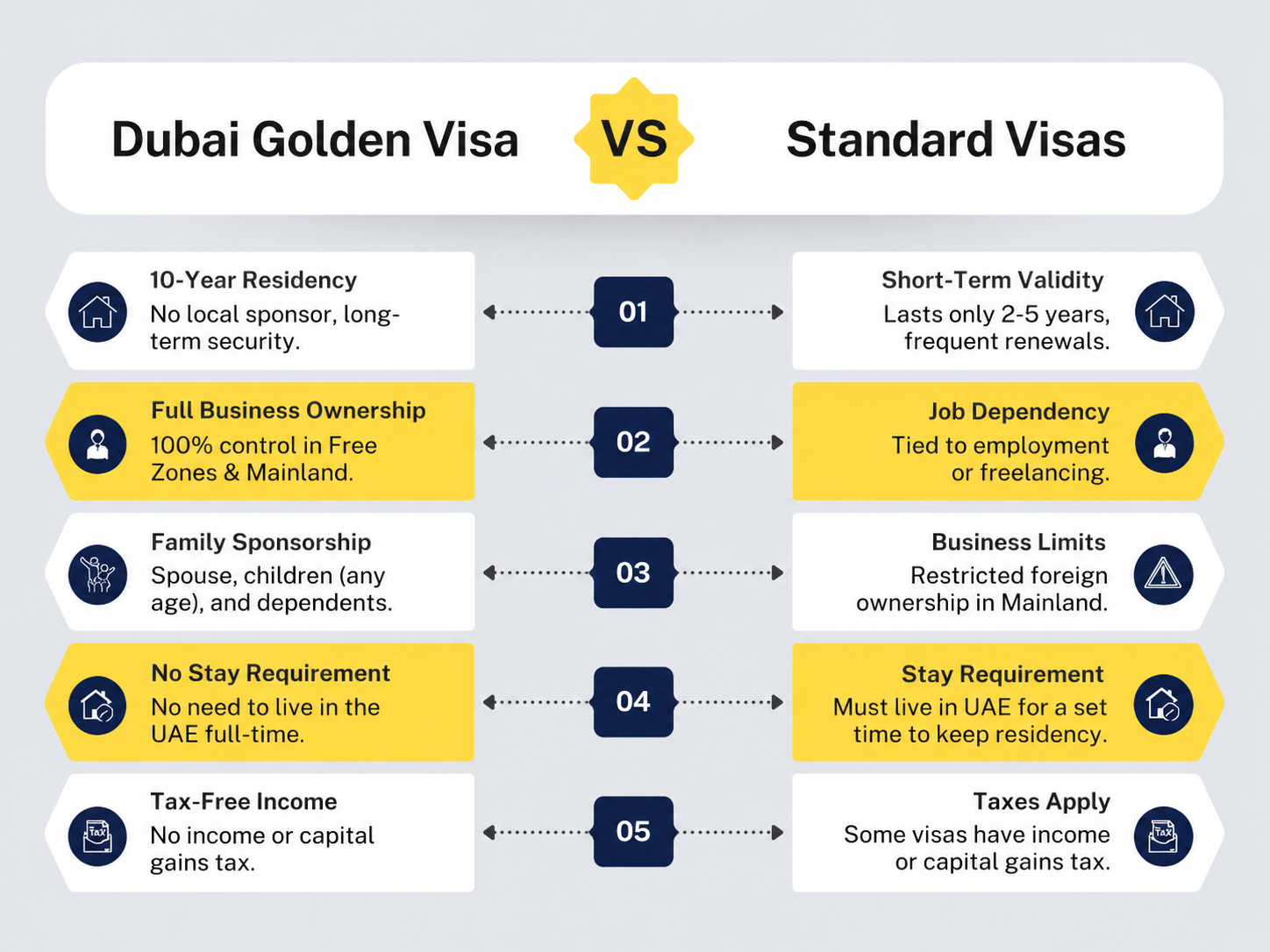
UAE Golden Visa vs Business and Employment Visas — What Investors Need to Know
The UAE operates several distinct residency tracks — and the term “business visa” is routinely used loosely to describe instruments that differ substantially in their legal structure, duration, and rights. For investors deploying capital into UAE real estate, understanding how the Golden Visa compares to other business-linked and employment-linked visa types is not a formality: the visa type you hold determines the stability, independence, and flexibility of your legal status in the UAE for years after the transaction closes.
The UAE Visa Landscape — What “Business Visa” Actually Means
In UAE immigration, the phrase “business visa” describes at least three different instruments depending on context. A short-term Business Visit Visa (30–90 days, non-renewable) covers commercial visits, meetings, and due diligence trips — it confers no residency rights and cannot be converted to a residency permit in-country. An Employment Residence Visa (2–3 years, employer-sponsored) is what most corporate relocations and professional hires produce: residency tied to an active employment contract with a UAE-registered entity. An Investor Visa (2–5 years) is issued against ownership of a UAE-registered company and lapses if the company is dissolved, deregistered, or the shareholding drops below the qualifying threshold. None of these is the Golden Visa — and all three are fundamentally contingent instruments.
The UAE also operates a Green Visa (5 years, self-sponsored) for skilled professionals earning above AED 15,000 per month and for freelancers with an annual income above AED 360,000. The Green Visa occupies a useful middle tier — more stable than an Employment Visa, less demanding than the Golden Visa threshold — but it remains income-dependent and subject to renewal conditions that tie the holder to sustained earnings in the UAE.
Employment Visa vs Golden Visa — Sponsorship and Stability
The structural difference that matters most for real estate investors is sponsorship. Under a standard Employment Residence Visa, the employer is the visa sponsor and holds the Labour Card (MOHRE work permit). If the employment relationship ends — by resignation, redundancy, or company closure — the visa lapses. The grace period for standard employment visa holders to regularise status after termination is 30 to 60 days. Changing jobs requires the existing sponsor to cancel the visa before the new employer can issue one, creating a residency gap that forces some holders to briefly exit the UAE.
The UAE Golden Visa is self-sponsored from the point of issuance. There is no employer sponsor, no Labour Card dependency, and no employment relationship that can be severed. If a Golden Visa holder who also holds a MOHRE work permit changes employers, the new employer cancels the old labour card and issues a new one — but the Golden Visa itself remains entirely unaffected. The residency continues uninterrupted for its full 10-year term regardless of employment status. Golden Visa holders are also explicitly exempt from UAE labour bans — the standard restriction that can prohibit an employee who resigns during probation from re-entering the UAE labour market for 12 months does not apply. The grace period on expiry or cancellation is 180 days, compared with 30–60 days on standard employment visas.

Rights Compared — Duration, Family, and Minimum Stay
The practical differences extend beyond sponsorship. Employment visas restrict family sponsorship: sons can typically be sponsored only up to age 18 (or 25 if enrolled as full-time students). The Golden Visa removes this ceiling — unmarried sons of any age who are enrolled students can be sponsored, unmarried daughters can be sponsored indefinitely, and the Golden Visa holder can sponsor their own parents for the full 10-year visa duration. These are not marginal differences for investors with adult children or multi-generational family arrangements in the UAE.
The minimum stay advantage extends to multi-jurisdictional investors: standard UAE residency visas lapse after six consecutive months outside the UAE, whereas the Golden Visa imposes no such condition — an investor operating across London, Mumbai, or Singapore maintains valid UAE residency without a fixed annual presence requirement.
Which Structure Fits Your Position
A short-term Business Visit Visa is appropriate for initial due diligence trips and property viewings — it is not a residency instrument and should not be treated as one. An Employment Visa suits executives and professionals whose UAE presence is employer-driven, whose time horizon is two to three years, and who are not anchoring personal capital in the market. An Investor Visa is appropriate for principals actively operating a UAE-registered business entity where the company itself — not the individual’s personal balance sheet — is the primary vehicle.
The UAE Golden Visa is the correct instrument for investors purchasing real estate at or above the AED 2 million threshold, for HNW individuals building multi-jurisdictional mobility structures, and for any investor whose time horizon extends beyond the renewal cycle of a standard visa. It provides what no employment-linked or company-linked instrument can: a decade of autonomous legal status in the UAE, held in the individual’s own name, independent of any employer, company, or residency condition. For a real estate investor deploying AED 2 million or more into the Dubai or Abu Dhabi market, the Golden Visa is not an add-on benefit — it becomes one of the principal legal and operational outcomes of the investment decision.
Processing — Timeline, Documentation and Fees
The Application Sequence
The UAE Golden Visa application for the property route follows a defined sequence:
- Title deed registration with DLD and confirmation of property value through DLD valuation.
- Application to the General Directorate of Residency and Foreigners Affairs (GDRFA) in Dubai, or the Federal Authority for Identity, Citizenship, Customs and Port Security (ICP) for other emirates.
- Medical fitness test and Emirates biometrics capture.
- Emirates ID issuance.
- Golden Visa stamp in passport.
The full sequence from title deed to active Golden Visa takes four to six weeks for standard applications without complications. Applications can be submitted online through the ICP or GDRFA portals, or processed through authorised typing centres and approved immigration service agencies in Dubai.
Documentation required: title deed (original), valid passport, property valuation certificate from DLD-approved valuer, proof of health insurance, and passport photographs. For off-plan property, an Oqood is required in place of the title deed, and in most standard cases the full visa issuance follows completion and DLD registration as described above — though the position should be confirmed with the developer and GDRFA at point of purchase.
GDRFA vs ICP — Which Processing Authority Applies
For investors purchasing property in Dubai, the Dubai Golden Visa application is processed through the General Directorate of Residency and Foreigners Affairs Dubai (GDRFA Dubai) — a separate authority from the federal ICP system used in Abu Dhabi and other emirates. This distinction matters operationally: GDRFA Dubai operates its own online portal (gdrfad.gov.ae), its own typing centre network, and its own fee schedule, which can differ marginally from ICP-issued visas in other emirates. Processing timelines through GDRFA Dubai run within the same standard window from the point of title deed registration. In April 2026, GDRFA and the Dubai Land Department signed a memorandum of understanding consolidating property-linked residency services into a unified digital platform — DLD property data is now integrated directly into the GDRFA application portal, removing the separate DLD verification step that previously added co-ordination time. Applications with a complete document package are reported to process within approximately five business days under the integrated system. The full step-by-step GDRFA application sequence — DLD registration, portal submission, document package, and processing — is covered in the Dubai Golden Visa guide.
Dubai is the most active emirate for Golden Visa issuance by volume — driven by the depth of its freehold property market and the concentration of qualifying AED 2 million+ transactions in areas such as Downtown Dubai, Dubai Marina, Palm Jumeirah, and Business Bay. Investors purchasing off-plan in Dubai should ensure the developer’s project is registered with DLD and that the Oqood interim registration is in place before initiating the Dubai Golden Visa application. GDRFA Dubai accepts applications from in-country applicants and from overseas via its e-services portal.
Government Fees and Total Cost
The government fees for a UAE Golden Visa application through the property route are fixed by the relevant authority and do not vary with property value. The application and issuance fee ranges from AED 2,800 to AED 4,800 depending on the processing channel — GDRFA Dubai or the Federal ICP. The medical fitness test and Emirates ID issuance adds approximately AED 700 to AED 1,000. Total government cost for the primary applicant is therefore in the range of AED 3,500 to AED 5,800, exclusive of the DLD property valuation fee (typically AED 3,500 to AED 5,000) and any advisory or typing centre fees.
Family Application Cost Estimate
For a family of four — primary holder plus spouse and two children — the government fee cost multiplies per person. Each family member’s residency visa carries its own processing and issuance fee. Families should budget approximately AED 15,000 to AED 25,000 in total government fees for full family residency establishment, inclusive of medical tests, Emirates IDs, and visa stamps for all members. This is a one-time cost per 10-year cycle; renewal at the end of the term carries a comparable fee structure.
A note on scam schemes: the UAE government has publicly clarified that Golden Visas are not available for a flat fee and are not for sale. Unofficial “nomination” schemes advertised at a flat rate — including schemes marketed at approximately AED 100,000 targeting Indian buyers — are fraudulent. All Golden Visa applications are subject to strict eligibility verification; a property purchase at or above AED 2 million registered with DLD is the qualifying event, not a payment to an intermediary.

Other Qualifying Pathways Beyond Property
The property route is one of several pathways to the UAE Golden Visa programme. Investors and professionals evaluating the UAE as a base should be aware of the full eligibility framework, as the most appropriate pathway depends on the individual’s circumstances and existing assets. The property route is the primary pathway for HNW real estate investors, but other routes are relevant for entrepreneurs, fund investors, and senior professionals.
Entrepreneur and Investment Fund Routes
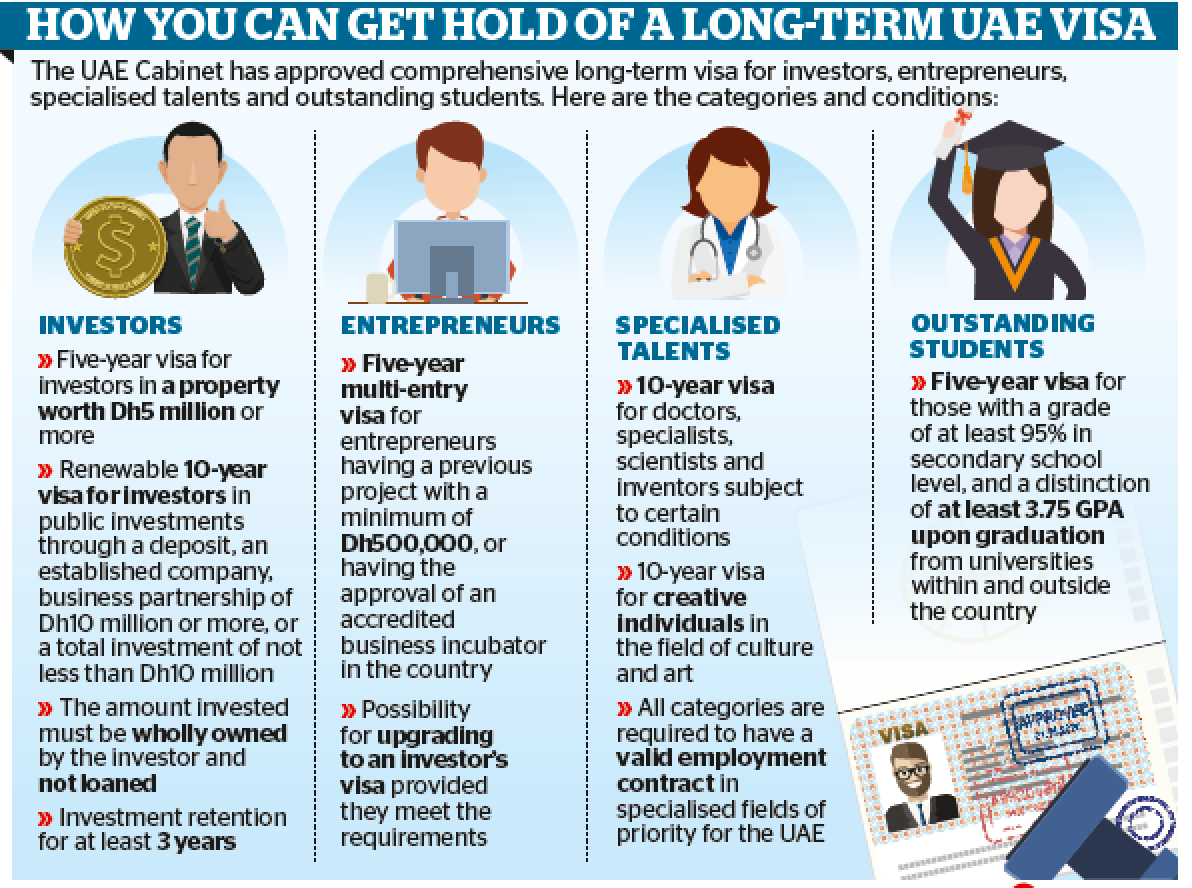
Entrepreneurs who own or partner in a registered UAE startup or SME generating annual revenue of at least AED 1 million qualify for the Golden Visa through the entrepreneur pathway. For those who prefer a capital-deployment route without direct property ownership, depositing a minimum of AED 2 million into a UAE-accredited investment fund or establishing a company with AED 2 million in paid-up capital qualifies under the investor category. The investment fund route is relevant for investors who prefer liquid capital allocation over the illiquidity of direct property, while still accessing the residency benefit at the same AED 2 million threshold.
Professional and Talent Categories
Highly skilled professionals qualify through a separate pathway that does not require any capital investment: a valid UAE employment contract, a degree classified by the Ministry of Human Resources and Emiratisation (MoHRE), and a monthly salary of at least AED 30,000. Scientists, researchers, and specialists with significant achievements in their fields can be nominated by relevant UAE authorities without meeting the salary threshold. Outstanding graduates from top-ranked universities — both UAE-based and globally accredited — are also eligible under the student and graduate pathway. These professional routes are outside the scope of this guide, which focuses on the property investment pathway, but are worth understanding for senior employees and founders who may qualify through professional credentials rather than capital.
Golden Visa Within a Broader Mobility Structure
UAE Residency vs Second Citizenship — What Each Provides
The UAE Golden Visa provides residency, not citizenship — the holder does not acquire UAE nationality through the programme. The Golden Visa is not designed as a citizenship-by-investment route and does not provide a direct or guaranteed pathway to UAE nationality — the UAE operates discretionary naturalisation pathways for exceptional categories, but these are separate from the Golden Visa programme. The practical distinction matters for investors building a multi-jurisdictional mobility structure: the Golden Visa provides a long-duration operational residency base in the UAE, though renewal remains linked to maintaining qualifying status. If the qualifying property is sold without replacement with another AED 2 million asset, the basis for renewal at the 10-year mark is affected.
For investors who want both the UAE’s practical advantages and a second citizenship that is programme-independent and passport-linked, the combination of a UAE Golden Visa and a Caribbean or European citizenship by investment programme is the standard structure. The residency vs citizenship investment distinction is covered in detail for investors evaluating which layer of legal status their mobility structure requires. The UAE Golden Visa handles the operational base; second citizenship handles the permanent legal status and travel document.
Investors benchmarking the UAE property residency route against European and Asian alternatives — Greece, Portugal, Malta, and Singapore — will find a full pre-decision comparison, including investment thresholds, stay obligations, and citizenship pathways, in our UAE residency by property investment analysis.
Golden Visa and the Real Estate Entry Decision
For investors evaluating UAE real estate with the Golden Visa as a consideration, the AED 2 million threshold is a meaningful portfolio sizing constraint that interacts with the financial return calculation. An investor with AED 1.5 million to deploy faces a choice: purchase at AED 1.5 million (higher yield on equity, no Golden Visa) or stretch to AED 2 million (Golden Visa qualification, slightly lower yield on equity, but full residency access). The decision depends on whether the residency benefit — banking access, school enrollment, operational base, family sponsorship — has practical value for the specific investor’s circumstances.
For many HNW investors evaluating a UAE allocation, the Golden Visa benefit at AED 2 million is worth the incremental capital above a lower entry point. The 10-year operational base has option value that is difficult to price precisely but meaningful for investors whose business, travel, or family circumstances make UAE residency useful. The full return framework for the Dubai real estate guide covers yield, appreciation, and Golden Visa sizing in the context of the overall investment case. For the advisory process covering Golden Visa application and citizenship by investment in parallel, DLD registration, GDRFA application, and family sponsorship run most efficiently as a coordinated workflow rather than a series of disconnected steps — investors working through an advisory typically complete the full sequence in a single structured engagement.