Global property diversification 2025 has moved from portfolio theory to immediate practice for a significant proportion of HNW investors worldwide. The combination of home-market tax compression, geopolitical recalibration across several major regions, and a UAE real estate market posting record transaction volumes has made cross-border property allocation a current-year decision rather than a deferred planning objective. For investors holding concentrated positions in UK, European, or Indian property and equities, the case for global property diversification is increasingly supported by yield, tax, and correlation dynamics across jurisdictions.
This guide examines the structural drivers of global property diversification in 2026, the specific case for UAE real estate as the anchor allocation within a diversified property portfolio, the correlation and residency instruments that accompany a UAE allocation, and the execution framework that determines whether the diversification objective is actually achieved or merely planned.
Greece is the only active European programme offering direct residential property qualification — no fund route, no donation requirement. At €250,000 in lower-demand mainland zones and €800,000 in Athens, Mykonos and Santorini, qualifying investment delivers immediate EU permanent residency and a seven-year pathway to EU citizenship. For investors building a dual-residency allocation — UAE for tax efficiency and an operational base, EU for Schengen mobility and a citizenship runway — Greece and the UAE are the two structurally compatible direct property routes. The full zone map, acquisition restrictions, citizenship timeline, and non-dom tax framework are covered in the Greece Golden Visa guide.

The Structural Case for Diversification in 2026
Tax and Yield Compression in Home Markets
The most immediate driver of global property diversification in 2026 is the compression of after-tax returns on home-market property in the jurisdictions where most HNW investors have concentrated their wealth. A UK buy-to-let investor operating at the additional rate faces a gross yield that begins at perhaps 5–6%, is reduced by mortgage interest restrictions, void provision, and agency costs to approximately 4–4.5%, and is then taxed at 40–45% on the income received — leaving a net-of-tax return in the 2.0–2.7% range. The capital gain on exit is taxed at 24% above the annual exemption. In Spain, rental income for non-residents is taxed at 19–24% regardless of allowable expenses, with CGT running 19–28% on disposal.
These returns are not the product of under-performance — they are the product of fiscal architecture. The tax structures of most European home markets systematically extract a substantial proportion of gross property returns before they reach the investor, year on year, compounding against the investor’s base across the entire hold period. Global property diversification addresses this not by identifying better managers or better locations within the same tax regime, but by reallocating capital to jurisdictions whose fiscal framework retains materially more of the gross return. The mechanics of this rebalancing — including the concentration risk embedded in single-jurisdiction portfolios and the proportions that make sense for a first cross-border allocation — are set out in the portfolio rebalancing guide for investors evaluating the allocation mathematics in detail.
Geopolitical Recalibration and Capital Mobility
Heightened military tensions across the wider Middle East in early 2026 brought geopolitical risk management into the active planning frame for many HNW investors who had previously treated it as a background consideration. Capital flows from jurisdictions with more direct conflict exposure accelerated. The pattern is consistent with prior periods of regional disruption: capital moves toward institutional stability, transparent legal systems, and demonstrated fiscal response capacity. The UAE announced a AED 1 billion ($273 million) business continuity package in response to regional disruption and maintained growth projections at 3.1% — a demonstration of the fiscal capacity that has made it a recurring destination for mobile capital during periods of regional stress.
The 2026 context adds a dimension that was less prominent in prior cycles. Western tax policy acceleration — UK carried interest changes, European exit tax tightening, Indian LRS documentation requirements — is simultaneously pressing capital toward lower-tax jurisdictions from the home-market side. Global property diversification 2025 is being driven by a pull factor (UAE structural advantages) and a push factor (home-market fiscal deterioration) operating simultaneously. That conjunction is what distinguishes 2026 structurally from prior years in which only one of the two forces was active, and it explains why the volume of cross-border allocation enquiries has accelerated materially in the first half of the year.

Why the UAE Is the Pivot Point for Global Property Diversification
Q1 2026 Transactions, Yields, and Demand
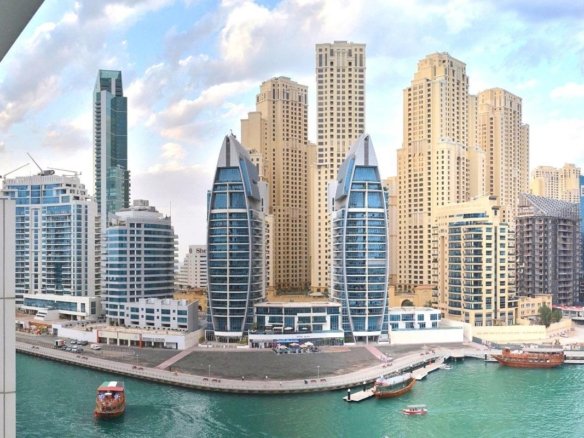
According to Dubai Land Department data, Dubai’s residential property market produced AED 246.12 billion in total transaction value in Q1 2026 — a 72% increase year-on-year — with the DLD recording 139,439 rental transactions in the same period. Mid-market corridors — JVC, Business Bay, Dubai Hills Estate, Al Furjan — are sustaining gross yields of 7–8.5%, with net yields of 6.5–7.5% after service charges and management fees. In a zero-income-tax environment, these net yields are fully retained by the investor — a structural advantage that no European or Indian residential market can replicate under current fiscal conditions.
The demand base driving these figures is structural rather than speculative. End-user relocation — professionals and families establishing UAE residency as a primary or secondary operational base — is the dominant driver of rental absorption in mid-market corridors. Dubai attracted 6,700 millionaires in 2024, the world’s largest single-year HNW inflow into any city, and that inflow has continued to drive residential rental demand into 2026. While luxury segments above AED 5 million have seen some price elevation in established zones, mid-market corridors continue to offer yield-to-price ratios that compare favourably with any comparable global destination. For investors evaluating global property diversification, the UAE mid-market offers a high-yield income stream in a hard currency, underpinned by structural end-user demand. The full market entry framework is set out in the Dubai real estate investment guide.
Zero-Tax Environment, Regulatory Certainty, and AED Stability
Three structural features of the UAE’s environment are relevant to global property diversification in ways that compound across a multi-year hold period. First, the UAE levies no personal income tax on rental receipts and no capital gains tax on residential property disposal for individual investors in freehold designated zones — a legal structure that retains the full net yield throughout the hold period and leaves the entire capital gain in the investor’s hands on exit. On a AED 2 million property appreciating at moderate rates over seven years, the absence of CGT retains a sum that would be taxed at 24% in the UK or 19–28% in Spain.
Second, the freehold property ownership system in designated zones provides foreign nationals with full title deed ownership rights — a legally clean, internationally recognised ownership structure that requires no corporate intermediary and carries no nationality restriction. Third, the AED has maintained a hard peg to the US dollar at 3.67 since 1997. For a rupee-based Indian HNW investor, an AED income stream is effectively a dollar-denominated income stream — and with the rupee depreciating approximately 2–3% per annum against the dollar over the past decade, the AED allocation adds a persistent currency return component that rupee-denominated home-market assets cannot provide. For sterling investors, the AED/GBP trend over the past five years has added a currency tailwind that compounds alongside the yield differential.

Building the Diversified Property Allocation
Geographic Spread and Correlation Management
A core principle of global property diversification is correlation management — structuring a property portfolio so that its components do not all respond to the same conditions in the same direction at the same time. UAE residential property has historically demonstrated low correlation to developed market equity indices and to European residential property cycles. The drivers of Dubai residential demand — end-user relocation, Golden Visa qualification, population inflow from global HNW migration, and supply constraint in established corridors — are largely independent of the sentiment and rate cycles that drive UK, European, and US property markets.
During the 2022 global rate shock, when UK and European property markets softened as mortgage rates doubled, Dubai residential prices appreciated 15–20% on structural end-user demand. During the 2020 COVID shock, Dubai residential fell 5–8% against global equity falls of 30–40%, before recovering strongly through 2021–2022. The correlation properties of UAE residential are not those of a conventional safe-haven asset — the market has its own risk factors, including developer delivery risk, supply pipeline dynamics, and sensitivity to global capital flow patterns. But the return stream demonstrably does not track European or UK residential markets or developed market equities closely, which is precisely the correlation property that a global property diversification strategy should be adding to a home-market-concentrated portfolio.

The Golden Visa Layer — Residency as Part of the Allocation
For investors deploying AED 2 million or more into UAE freehold real estate in their own name, the Golden Visa converts the capital allocation into a 10-year renewable UAE residency permit with no minimum annual stay requirement. In the context of global property diversification, this is a structural benefit that most competing diversification destinations cannot match: the investment generates yield, potential appreciation, and a legal operational status in a single transaction. The residency instrument provides UAE-based school access, healthcare, banking relationships, and an operational base without employer sponsorship — functioning as a mobility option that operates independently of the investor’s primary residence decision.
For families evaluating global property diversification as part of a broader mobility restructuring, the AED 2 million threshold is a meaningful portfolio sizing anchor. The property allocation and the residency instrument are co-incident rather than requiring separate transactions in separate jurisdictions with separate legal and advisory costs. Investors deploying slightly below AED 2 million often find it worth extending the allocation modestly to access the residency benefit alongside the financial return. The qualification mechanics — off-plan eligibility, mortgaged property rules, DLD registration requirements, and the sole-owner condition — are covered in the UAE residency by property investment guide.

Executing Global Property Diversification in 2026
Entry Strategy — Corridor Selection and Structuring
The execution of a global property diversification strategy in the UAE is not uniform across all market segments. Luxury units above AED 5 million in DIFC, Palm Jumeirah, or Jumeirah Bay produce gross yields of 3–5% — structurally too compressed to justify the allocation on an income basis for most diversification-motivated investors whose primary objective is yield and appreciation rather than trophy positioning. Mid-market corridors — JVC, Business Bay, Dubai Hills Estate, Al Furjan — produce the yield outcomes that underpin the diversification case, with a broader end-user resale pool on exit that supports liquidity management within a multi-asset portfolio.
The AED 2 million threshold is a meaningful decision point in segment selection for two reasons beyond its alignment with the Golden Visa. It also represents the practical entry point for non-resident mortgage financing, where the UAE Central Bank’s 50% LTV ceiling on residential purchases means a AED 2 million acquisition requires approximately AED 1.16 million in equity (including the 4% DLD fee and approximately 2% agency commission), with the balance financed at current non-resident rates of 5.5–6.0%. At 7% gross yield on the full property value, a leveraged position in a well-selected mid-market corridor is potentially cash-flow positive from settlement. Leverage changes the effective cash-on-cash return profile materially and should be evaluated as an integral part of the entry decision — not as a downstream financing consideration separate from the allocation.

The Coordination Requirement
Global property diversification executed across property acquisition, mortgage financing, residency planning, and tax sequencing involves decisions that are interdependent in ways that create avoidable cost, delay, and execution risk. Property selection determines Golden Visa eligibility. Financing structure determines the equity required at acquisition and the mortgage approval probability — the wrong lender approach for a complex income file adds delay and creates a declined-application record that complicates subsequent attempts. Residency timing interacts with the home-jurisdiction tax departure planning — for UK investors, the temporary non-residence rules governing capital gains crystallised in the years following departure require careful ordering of asset disposals relative to residency change. For Indian HNW investors, FEMA and LRS compliance requirements interact with the property acquisition timeline and repatriation planning.
Each of these layers has its own sequencing logic — and errors made at one stage compound into the next. The multi-jurisdiction coordination requirement is not an administrative detail — it is the central execution challenge of global property diversification 2025. For investors whose planning simultaneously spans residency restructuring, citizenship acquisition, and property allocation, the global mobility planning framework for 2026 sets out the sequencing logic for managing these decisions as a coordinated whole rather than a sequence of independent specialist engagements. Helis operates across real estate, mortgage, and citizenship advisory in a single integrated engagement — structured around the needs of HNW investors for whom global property diversification 2025 is a multi-dimensional planning exercise, not a standalone acquisition.