This article covers the investment mechanics, fund due diligence and CMVM compliance. For the full programme overview, eligibility and application process, see our Portugal Golden Visa guide.
The Portugal Golden Visa investment framework changed fundamentally in October 2023. Residential property (the qualifying route that had defined the programme for a decade) was closed to new applicants under Law n.º 56/2023. What remained were capital-deployment routes centred on fund subscriptions, scientific research, job creation and cultural heritage support. Of these, the qualifying investment fund route now accounts for the substantial majority of new ARI (Autorização de Residência para Investimento) applications.
This page covers the current Portugal Golden Visa investment routes in full: fund eligibility criteria, CMVM regulation, how to access and select a qualifying fund from outside Portugal, residency rights and the seven-day presence rule, AIMA processing timelines, the citizenship framework as revised by Lei Orgânica n.º 1/2026 (in force 19 May 2026), and tax positioning for UAE-based and NRI investors.
The programme continues to offer one of the most structurally accessible pathways to European residency and eventual EU citizenship available through the broader golden visa programmes landscape. The timelines, processing realities and citizenship framework have, however, changed materially since 2023. This page reflects the position as of June 2026. Investors should verify current requirements with qualified Portuguese immigration counsel before committing capital.

ARI Investment Routes After the 2023 Reform
What the Reform Closed
Portugal’s ARI programme was built around residential property investment for most of its operational life. The October 2023 reform, enacted under Law n.º 56/2023, removed that option for new applications. Transfers of EUR 500,000 or more into Portuguese residential real estate no longer qualify for ARI residency from that date. Applicants who invested through the residential property route prior to October 2023 retain their existing residency rights under the Portugal Golden Visa programme and can renew their permits on the original basis for the duration of those permits.
Commercial real estate (hotels, commercial units and heritage rehabilitation properties) sits under separate legislation and is not the same as the residential property route that was closed. New investors should not conflate these categories when assessing current eligibility.
Routes That Remain Open
Post-reform, the operative ARI investment routes are as follows.
Fund subscription: EUR 500,000 minimum in a qualifying CMVM-regulated investment fund. This is the dominant route and the primary subject of this page. The fund must meet a defined set of criteria covering regulation, real estate exclusion, Portuguese company allocation and maturity.
Scientific research: EUR 500,000 minimum invested in public or private scientific research activities carried out by research institutes integrated in Portugal’s national scientific and technological system. In practice, fewer investment migration advisory firms maintain active deal pipelines for this route compared to the fund route.
Job creation: EUR 500,000 invested in a company registered in Portugal creating at least five permanent jobs for a minimum of three years. An equivalent route applies to investment in an existing Portuguese company with at least five years of operation, provided it creates or maintains at least five permanent jobs for three years.
Cultural heritage: EUR 250,000 minimum in artistic production or in the recovery or maintenance of national cultural heritage. The lower threshold makes this route notable, but qualifying projects and structured advisory infrastructure are limited in the market.
Why the Fund Route Accounts for Most New ARI Applications
The Portugal Golden Visa investment fund route has absorbed the majority of new ARI applications since the property route closed. The structured nature of CMVM-authorised funds, the absence of any property management obligation and the availability of professionally managed due diligence documentation all make the fund route the operationally practical default for non-resident investors. For UAE-based and NRI investors who do not intend to operate a business or research institution in Portugal, the fund route is effectively the single viable post-2023 pathway. Once subscribed, investors proceed through the Portugal Golden Visa application process to obtain their ARI residence permit.

Fund Investment: Eligibility Criteria and Structure
Portugal’s ARI legislation sets mandatory criteria that a qualifying fund must meet at the time of the investor’s subscription. These criteria are enforced by CMVM and must be confirmed by the fund manager in writing before any investor subscribes.
CMVM Regulation and the Real Estate Exclusion
The fund must be authorised by and registered with CMVM, Portugal’s securities market regulator. Funds registered only in Luxembourg, Ireland or other jurisdictions, even where marketed actively in Portugal, do not qualify for ARI purposes. CMVM maintains a public register of authorised collective investment undertakings, and investors should cross-reference the fund’s CMVM registration number against this register before subscribing.
Law No. 56/2023 amended the ARI framework to state that qualifying investments cannot be intended, directly or indirectly, for real estate investment. In practice, CMVM-authorised funds that hold direct real estate assets — buying, selling or renting property — are ineligible. The boundary on indirect exposure, however, is not fully resolved in the implementing legislation: funds that invest in operating companies which own real estate as part of their business infrastructure (such as hospitality, healthcare or logistics) may still qualify, provided the investment objective is not real estate itself. This distinction has not yet been codified in the Decree-Law and remains subject to regulatory interpretation. Investors should obtain a written legal opinion from a Portugal-qualified practitioner on whether a specific fund’s portfolio crosses the indirect exposure line before subscribing. Investors should obtain a written representation from the fund manager that real estate exposure is excluded and request confirmation that this is monitored on an ongoing basis.
The 60% Portuguese Company Allocation Rule
At least 60% of the fund’s capital must be allocated to companies established and registered in Portugal. These underlying companies must not themselves be real estate companies. The 60% rule is verified at the point of CMVM authorisation and must be maintained throughout the fund’s life. Fund managers are required to report compliance to CMVM on a periodic basis.
Investors should request copies of CMVM compliance reports and, where available, independent auditor confirmations of the 60% allocation as part of their due diligence process. A fund that drifts below 60% Portuguese company exposure, whether through portfolio disposals, write-downs or capital reallocation, may lose its ARI qualifying status, exposing investors whose ARI permits are tied to that fund.
Minimum Maturity, Lock-Up and Fund Term
The fund must have at least five years of remaining maturity at the time of the investor’s subscription. This is a hard statutory requirement. A fund that has been operating for six years on a ten-year term has four years of remaining maturity at year six. It would no longer qualify for new ARI subscriptions at that point.
In practice, most qualifying funds are structured with a ten-year total term to ensure they remain eligible for new subscriber intake throughout the fundraising period. Fund terms of seven to ten years are the most common in the Portuguese ARI market. Lock-up provisions typically prohibit full redemption for the first five years, aligning with the ARI permit renewal cycle and the investor’s own presence requirement.
Some funds offer limited quarterly liquidity windows after year three, subject to available cash within the fund structure. These provisions are fund-specific, are not guaranteed under ARI legislation and should not be relied upon in capital planning.
Key Fund Parameters at a Glance
Minimum investment: EUR 500,000. Fund authorisation: CMVM-registered in Portugal. Real estate exposure: direct investment prohibited; indirect exposure legally unsettled — confirm with legal counsel. Portuguese company allocation: minimum 60% of capital. Minimum remaining maturity at subscription: five years. Typical fund term: seven to ten years. Lock-up period: typically five years minimum.
Splitting EUR 500,000 Across Multiple Qualifying Funds
ARI legislation permits the EUR 500,000 minimum to be split across two or more qualifying funds, provided each fund independently meets all eligibility criteria: CMVM authorisation, real estate exclusion, 60% Portuguese company allocation and five-year minimum remaining maturity. The combined subscription must total at least EUR 500,000. This approach allows investors to diversify across fund managers, strategies and sectoral exposures within the Portuguese company universe while satisfying the single statutory threshold requirement.
Types of Qualifying Funds: Sector Profiles
CMVM-authorised ARI funds are not a single category — they span a range of strategies, asset classes and risk profiles within the Portuguese company universe. The unifying requirement is the 60% Portuguese company allocation and the real estate exclusion; within those constraints, fund managers operate across several identifiable sectors.
Venture Capital Funds
VC funds targeting early-stage Portuguese technology companies represent the highest-risk, highest-upside category within the ARI fund universe. Managers typically build portfolios of 10–20 seed and Series A companies across the Lisbon and Porto tech ecosystems, with exposure to fintech, healthtech, agritech and SaaS. Lock-up periods tend to run longer than PE equivalents — eight to ten years is common — reflecting the longer maturation curve of early-stage positions. Capital return is predominantly back-ended, and investors should not anticipate interim distributions. The 60% allocation to Portuguese companies is straightforward to satisfy in a domestic VC mandate, though investors should verify that portfolio company registrations and operational centres of gravity are in Portugal, not simply incorporated there for convenience.
Private Equity Funds
PE funds acquire controlling or significant minority stakes in established Portuguese SMEs and mid-market businesses, typically targeting companies with EUR 5–50 million in revenue across manufacturing, business services, consumer and industrial sectors. Return profiles are more predictable than VC but the capital is similarly illiquid for the fund term. PE structures in the Portuguese ARI market often include a combination of equity and shareholder loans, and fund managers with a track record in Portuguese markets are preferable to international managers deploying a first-fund strategy into a market they do not know operationally. Portuguese PE management fees typically run at 1.5–2% annually on committed capital, with carried interest at 20% above an 8% hurdle.
Growth Equity Funds
Growth equity funds occupy the space between VC and buyout PE: minority stakes in profitable Portuguese companies with established revenue seeking capital to scale — geographic expansion, product development or acquisition. Risk is lower than VC because the underlying businesses are already generating cash; return timelines are typically five to seven years. For ARI investors prioritising capital preservation alongside the residency objective, growth equity funds often represent the most balanced structural fit. Several CMVM-authorised fund managers operating in this space have demonstrable Portuguese portfolio track records spanning ten or more years, which provides a basis for manager-level due diligence that VC-stage funds cannot offer.
Technology and Innovation Funds
A subset of VC and growth mandates, technology and innovation funds specifically target Portuguese companies in regulated innovation sectors: medtech, defence technology, clean energy software, and deep tech. Some managers in this category benefit from co-investment alongside Portuguese government innovation bodies, which can provide a degree of pipeline validation. Investors should distinguish between funds that genuinely concentrate on innovation-sector companies and those that apply the label to a standard diversified SME portfolio — the CMVM prospectus and investment policy section of the fund documentation will confirm which companies and sectors the mandate actually targets.
Hospitality and Tourism Operating Funds
Funds investing in hospitality and tourism operating companies — hotel management businesses, tourism concessions, food and beverage operations — represent a sector where the boundary with the real estate exclusion requires active attention. A fund investing in a hotel management company that leases its properties from third parties presents a fundamentally different risk profile from a fund whose portfolio company owns the hotel building. The former invests in an operating business; the latter creates indirect real estate exposure that may fall within the scope of Law 56/2023 Article 3(5), depending on how CMVM interprets the indirect real estate exclusion for that specific fund structure. Investors considering hospitality-sector funds should obtain a specific written legal opinion confirming that the fund’s portfolio companies hold real estate, if at all, as an operational necessity rather than as an investment objective. This is not a reason to exclude the sector — hospitality funds have produced consistent returns in Portugal’s tourism economy — but it is a due diligence step that cannot be skipped.
Renewable Energy and Infrastructure Operating Funds
Portugal’s renewable energy sector — solar, wind and green hydrogen — has attracted a growing number of CMVM-authorised funds targeting operating companies in the energy transition space. These funds typically invest in Portuguese companies that develop, operate or service renewable energy assets rather than in the assets themselves, maintaining the distinction between an operating company investment and direct infrastructure or real estate ownership. Return profiles tend toward yield-oriented distributions from operational cash flows rather than capital appreciation events, which suits investors seeking predictable interim income rather than terminal value upside. Infrastructure operating funds are among the more defensible categories from a real estate exclusion standpoint, provided fund documentation confirms the portfolio companies are operating businesses, not special purpose vehicles holding physical assets.
Selecting a Fund from Outside Portugal
How UAE-Based Investors Access Qualifying Funds
UAE-based investors typically engage a specialist ARI advisory firm or a Portuguese law firm with an investment migration practice to identify and access qualifying funds. Direct subscription without structured legal and tax advice from a Portugal-qualified practitioner carries material risk: fund eligibility can change if the fund drifts out of compliance with the 60% allocation rule or the real estate exclusion. What happens to an existing ARI permit holder in this scenario is not explicitly codified in ARI legislation: no statutory cure period is defined, and AIMA has not published a formal position on how it treats renewal applications where the underlying fund has lost CMVM qualifying status. The risk is real but the regulatory outcome is administratively uncertain. Investors whose fund loses qualification should seek immediate advice from a Portugal-qualified immigration lawyer rather than assume a defined outcome.
Some CMVM-authorised fund managers distribute through international private banks with UAE branch presence, making it possible to subscribe through an institution the investor already holds a relationship with. This convenience should not replace independent confirmation of the fund’s current ARI qualifying status. The fund manager’s marketing materials and the investor’s bank’s distribution documents are not substitutes for a legal opinion from Portuguese immigration counsel on the specific fund’s current compliance position.
Due Diligence: Fees, Manager Authorisation and Performance Transparency
Qualifying fund structures carry management fees that typically range from 1.5% to 2.5% per annum of committed capital, plus performance fees of 15% to 20% on returns above a defined hurdle rate. The combined cost drag over a seven-to-ten year fund term is material and substantially exceeds the headline management fee figure. Investors should model total fees over the anticipated holding period before comparing net expected returns across fund options.
Fund manager authorisation is separate from fund authorisation and must be verified independently. The managing entity must hold a valid CMVM management licence as a sociedade gestora de fundos de investimento. Both the specific fund’s CMVM registration and the management company’s CMVM licence should be confirmed in the public CMVM register before any subscription documents are signed.
Performance track record for many qualifying ARI funds is limited: most were established after 2020 in response to ARI demand and have not yet returned capital to investors. Fund managers who represent their track record via predecessor funds in different strategies or jurisdictions should be asked for like-for-like Portuguese company investment performance data specifically.
Due Diligence Checklist for Non-Resident Investors
CMVM fund registration number confirmed in the public CMVM collective investment register. Fund manager holds valid CMVM sociedade gestora management licence. Offering documents confirm 60% Portuguese company allocation and real estate exclusion in writing. Remaining maturity at planned subscription date exceeds five years. Full fund term, lock-up provisions and any liquidity windows documented. Management fee, performance fee and total expense ratio modelled over holding period. Portuguese immigration counsel has confirmed current ARI qualifying status of the specific fund, not historical status or marketing material representation.
NRI Investors: Capital Transfer Considerations
For Indian nationals resident in the UAE (NRIs), the capital transfer to a Portuguese qualifying fund flows from a UAE bank account to the fund’s designated Portuguese collection account. This transfer does not involve India’s Liberalised Remittance Scheme, which applies to resident Indians remitting from India-held accounts. NRI investors remitting from UAE accounts should ensure the transfer instruction is documented as an investment in a foreign regulated fund, and retain wire confirmation, CMVM fund registration documentation and legal opinion letters as supporting documents for the ARI application submission package.

Residency Rights, the 7-Day Rule and Family Inclusion
What the ARI Permit Grants
An approved Portugal Golden Visa investment application confers a Portuguese residence permit renewable every two years (initial permit is one year). The permit grants full Schengen area travel rights: visa-free access to all 26 Schengen member states, subject to the 90-day-within-any-180-day limit applicable to third-country nationals. ARI holders may live and work in Portugal without additional work permits. The permit also confers the right to open Portuguese bank accounts and to access Portugal’s national healthcare system on the same basis as residents. The full eligibility conditions, documentation requirements and application stages are covered in our Portugal Golden Visa guide.
Seven-Day Annual Presence Requirement
The ARI imposes a minimum physical presence of seven days in Portugal per year of the permit, or 14 days per two-year renewal period. This is among the lowest physical presence obligations of any comparable European residency programme. The seven-day minimum is a statutory floor, not an average. Investors must meet it in each qualifying period, not across the life of the permit.
Days in Portugal are calculated as calendar days of physical presence. Arrival and departure each count as one day. Neither Law No. 23/2007 nor Regulatory Decree No. 84/2007 specifies the exact documents required to prove physical presence. In practice, AIMA typically requests: boarding passes for entry into and exit from Portugal (the primary evidence of travel dates); and invoices issued with a Portuguese tax identification number (NIF) for each day of the stay, which may include hotel receipts, restaurant bills, café receipts or any other transaction generating a NIF-stamped invoice. Bank statements and Schengen passport stamps serve as corroborating evidence but are not the primary documents AIMA requests. All family members included in the permit must provide their own boarding passes; NIF invoices can reference the principal applicant’s NIF where family members are named. AIMA reviews presence documentation at every renewal submission and may request additional evidence if the documentation is incomplete.
Family Members: Eligibility and Age Limits
The ARI permits dependent family members to hold permits on the same qualifying investment as the principal applicant. Qualifying dependents include: the spouse or registered civil partner; minor children of either spouse; dependent adult children of either spouse up to age 26 if enrolled full-time in an educational institution; dependent parents of the principal applicant or spouse; and minor siblings under the legal guardianship of the principal applicant.
Each dependent family member must independently satisfy the seven-day or 14-day presence requirement at renewal. AIMA applies the presence requirement per permit holder, not per family unit. Children who complete their studies and cease to qualify as dependents must apply for independent Portuguese residence status if they wish to maintain their Portuguese residency rights independently of the principal applicant.
AIMA Processing: Current State and Realistic Timelines
The 55,000-Case Backlog
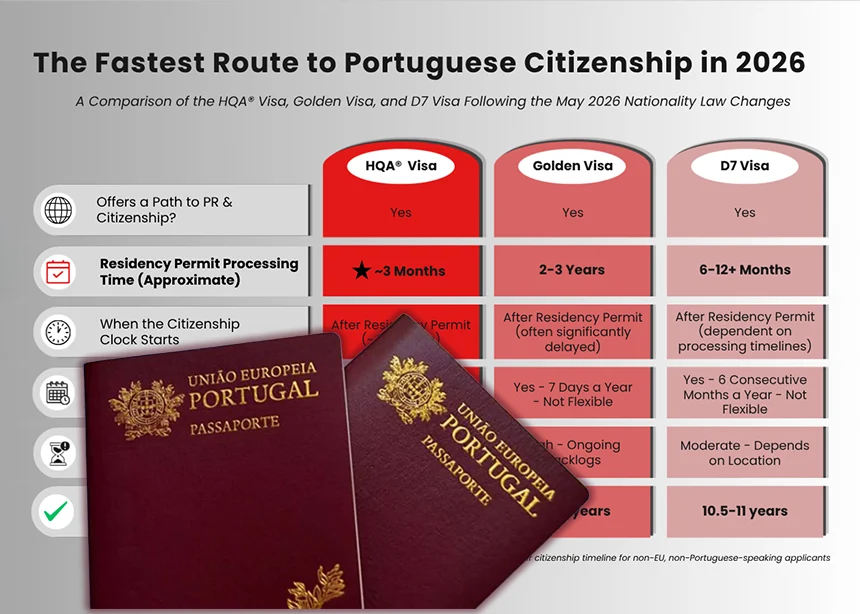
AIMA (Agência para a Integração, Migrações e Asilo), which absorbed the immigration functions of the former SEF in 2023, inherited a structural processing backlog that had been building since 2021. By 2025, the number of pending ARI applications, including new applications, renewals and dependent additions, exceeded 55,000 cases (based on publicly reported 2025 figures). The statutory legal target for ARI processing is 90 days. That target is being exceeded by a factor of approximately twelve, with average actual processing times running at around 34 months from submission to issuance of the first physical residence card (as of mid-2026 reporting).
As of mid-2026, AIMA reports that most primary applicants whose biometric appointments were pending from 2022 to 2025 have now been scheduled for 2026 appointments. This represents a meaningful operational improvement. However, scheduling of dependent family member biometric appointments lags behind primary applicant scheduling, and processing times on an individual case basis continue to vary significantly depending on application completeness and submission date.
Stage-by-Stage Timeline
ARI processing runs in three sequential stages, each adding to the total elapsed time from submission to card issuance.
Processing Stages
Application submission and acknowledgement: the investor submits the ARI application through the ARI online portal with the full supporting document package, including fund subscription confirmation, criminal record clearance from all countries of residence, apostilled documents, health insurance covering Portugal, proof of EUR 500,000 fund subscription and the fund’s CMVM registration documentation. AIMA issues an acknowledgement reference but does not provide a projected processing date at submission.
Biometric appointment: AIMA schedules the applicant and each dependent for an in-person biometric data collection appointment at an AIMA office in Portugal. This stage has been the primary processing bottleneck since 2021. Current wait times from submission to biometric appointment scheduling range from approximately nine to 24 months, with case-to-case variance remaining high.
Permit issuance: following biometrics, AIMA processes the application to decision and issues the physical residence card. This stage adds approximately six to twelve months. Total end-to-end timeline from submission for new Portugal Golden Visa investment applications filed in 2025 or 2026 should be planned at a minimum of 18 months and, in a conservative model, up to 36 months. During processing, AIMA issues a temporary certificate of residency (certificado de residência temporária) confirming the applicant’s pending legal status. These certificates are accepted by most Schengen member states for travel purposes, though individual border authority practice at specific crossings can vary.
Legal Escalation When the 90-Day Deadline Is Missed
Portugal’s administrative law requires AIMA to decide on ARI applications within 90 days of submission. When that deadline is missed without a decision being issued, applicants have the right to file a formal administrative complaint and, if that complaint is unresolved within 30 days, to initiate administrative court proceedings challenging the delay. Legal action has become a routine tool for ARI applicants with applications pending beyond 12 months without biometric scheduling. Court proceedings frequently accelerate biometric scheduling in cases where administrative complaints alone have not. Applicants in this position should engage Portuguese immigration counsel to assess the appropriate escalation threshold for their specific case.
Citizenship Timeline Under Lei Organica 1/2026
The most material change to the Portugal Golden Visa investment pathway in 2026 is not to the ARI residency programme itself but to the citizenship framework it ultimately connects to for investors seeking EU naturalisation. Naturalisation follows the residence period obtained under the Portugal Golden Visa programme.
What Changed on 19 May 2026
Lei Orgânica n.º 1/2026 was published in Diário da República n.º 95/2026, Série I, on 18 May 2026 and entered into force on 19 May 2026 under Artigo 8.º of the statute. The law amends Portugal’s nationality framework and revises the residency period required before an applicant may apply for naturalisation.
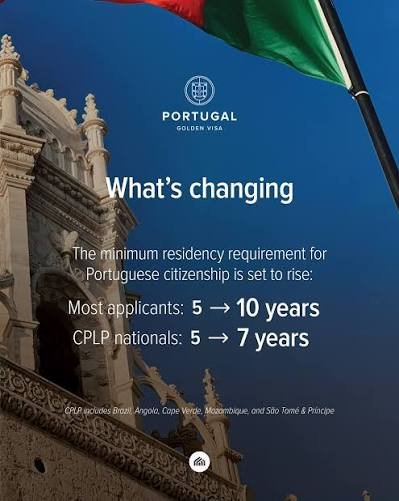
For nationals of EU member states and member states of the CPLP (Comunidade dos Países de Língua Portuguesa: Brazil, Angola, Mozambique, Cape Verde, São Tomé and Príncipe, Guinea-Bissau, Equatorial Guinea and East Timor): seven years of legal residence in Portugal is required before a naturalisation application may be submitted.
For all other nationalities, including UAE residents, Indian nationals and investors from most of Asia, the Middle East and the Americas outside CPLP: ten years of legal residence is required. This replaces the prior universal five-year requirement for both groups. The qualifying residency period is counted from the date the first residence permit is issued, not from the date of ARI application submission.
The Transitional Rule: Applications Filed on or Before 18 May 2026
Artigo 7.º.2 of Lei Orgânica n.º 1/2026 preserves the prior five-year regime for nationality applications submitted to the IRN (Instituto dos Registos e do Notariado) on or before 18 May 2026. Applications submitted by that date continue to be processed under the prior Lei 37/81 nationality regime regardless of when AIMA or the IRN decides them. Investors who had already filed a completed nationality application to the IRN by 18 May 2026 are fully protected by this transitional rule and proceed on the original five-year framework.
Residency-Stage Investors and the Disputed Clock
For ARI investors who hold a residence permit but have not yet filed a nationality application, the statute is silent on whether residency time already accrued before 19 May 2026 counts toward the new seven- or ten-year requirement. This transitional question is currently the subject of an ongoing collective legal action in the Portuguese courts. The Portuguese Government has 90 days from 19 May 2026 to publish an updated Regulamento da Nacionalidade under Artigo 4.º, which may clarify this point. Investors at the residency stage without a filed nationality application should plan conservatively: model a ten-year horizon from the date of first permit issuance for non-EU, non-CPLP nationals. Additional requirements introduced by the new law include a civic knowledge test, a formal declaration of adherence to democratic rule-of-law principles and a criminal record threshold of two years for disqualification purposes.
The Compounding Effect of Processing Delays on Citizenship Planning
With first card issuance currently taking 18 to 36 months from ARI application submission, and the citizenship qualifying period running from permit issuance date, the practical timeline to naturalisation for a non-EU, non-CPLP investor applying in mid-2026 is substantially longer than the ten-year statutory figure alone suggests. An investor who submits in mid-2026 and receives their first card in mid-2028 faces a naturalisation date of no earlier than mid-2038, approximately twelve years from the point of application. This compounding effect is a material planning factor that investors should model explicitly when comparing the Portugal Golden Visa investment route against alternative European residency pathways.

Permanent Residency at Year Five
After five years of legal residence from the date of first permit issuance, ARI holders are eligible to apply for permanent residency under the investment route (regime específico), which waives the general physical residence requirement. A2-level Portuguese language proficiency, verified through a CAPLE examination or recognised equivalent, is required at this stage. No new investment obligation applies at PR. Family members holding ARI permits receive independent PR cards. The fund maturity requirement means that for most investors the capital planning milestone and the PR eligibility date coincide.
Fund Liquidation at Year Five
The five-year minimum maturity requirement for qualifying ARI funds means that, for investors who subscribed a fund with a term meeting the statutory minimum, the earliest fund redemption date aligns approximately with PR eligibility. ARI legislation does not require the investor to maintain the qualifying fund investment after the PR application is approved. Investors who obtain PR may instruct the fund manager to redeem their units at the next available liquidity window, subject to the fund’s specific redemption terms and cash availability. This creates a defined capital planning milestone: five years from permit issuance, the investor may apply for PR and initiate fund redemption proceedings. The citizenship pathway continues from this point on the ten-year clock without any further investment obligation.
Tax Considerations for UAE-Based and NRI Investors
IFICI (NHR 2.0) from January 2025: Scope and Eligibility
The Incentivo Fiscal à Investigação Científica e Inovação (IFICI), informally referred to as NHR 2.0, replaced the former Non-Habitual Resident tax regime from 1 January 2025. IFICI provides a 20% flat income tax rate on qualifying Portuguese-source income for a ten-year period, available to new Portuguese tax residents who have not been tax resident in Portugal during the five years immediately preceding their application. Eligibility is substantially narrower than the prior NHR regime, centred on scientific research, innovation, technology and a defined list of specialised professional roles set by Finance Ministry decree. Most passive Portugal Golden Visa investment holders, those who subscribe a qualifying fund but do not carry out qualifying activities in Portugal, are unlikely to meet IFICI eligibility criteria. Investors intending to establish Portuguese tax residency should obtain independent Portuguese tax advice to confirm their IFICI status before relocating.
Foreign Income Treatment: IFICI and the Prior NHR Regime
For investors who do qualify for IFICI: foreign-source dividends, interest, royalties and capital gains from non-Portuguese sources benefit from a Portuguese income tax exemption, provided the income does not arise from a jurisdiction listed on Portugal’s register of non-cooperative territories for tax purposes. The UAE is not on that list. Investors who obtained Non-Habitual Resident status before 31 December 2024 are grandfathered for their remaining NHR term, continuing on the original terms for up to ten years from their original NHR registration date.
ARI Residency and Portuguese Tax Residency: A Material Distinction
UAE-based investors holding an ARI permit are not automatically Portuguese tax residents. Portuguese tax residency is triggered by physical presence of 183 days or more in Portugal in a calendar year, or by the establishment of habitual residence in Portugal as assessed on the facts. An ARI investor who meets only the statutory seven-day annual minimum and whose primary residence, business operations and centre of life remain in the UAE does not typically become a Portuguese tax resident.
The UAE Golden Visa confers the legal right to reside in the UAE; it does not automatically confer UAE tax residency. UAE tax residency is a separate determination made by the UAE Federal Tax Authority (FTA): an individual must meet either the 183-day physical presence threshold within a 12-month period, or 90 days of presence combined with qualifying demographic and economic ties to the UAE (the 90-day route does not establish treaty-purpose tax residency). A UAE Tax Residency Certificate (TRC) must be applied for separately through the FTA. Investors holding both a Portugal ARI and a UAE Golden Visa should take qualified advice on how each jurisdiction’s tax residency rules interact, and should not assume that Golden Visa status alone establishes UAE tax residency for treaty or home-country reporting purposes.
The ARI programme, for the majority of UAE-based HNW investors who use it, provides European residency optionality and an eventual citizenship pathway without forcing immediate Portuguese tax residency or requiring relocation. That structural separation between residency rights and tax residency is a defining operational feature of the programme at the seven-day minimum presence level. Investors seeking to understand how Portugal Golden Visa investment fits within a broader residency and citizenship advisory strategy should engage qualified Portuguese immigration and tax counsel alongside Helis’s investment migration practice.
For the complete Portugal Golden Visa application process, eligibility conditions, and step-by-step documentation guidance, see our programme guide.
Investors who need a passport in parallel with the ARI residency pathway — rather than waiting five or more years for Portuguese citizenship — frequently combine this structure with a Caribbean programme. St Kitts and Nevis citizenship by investment delivers a second passport in 45–60 days, providing immediate travel mobility while the Portugal ARI pathway matures toward naturalisation.
Factual accuracy caveat: investment thresholds, AIMA processing data, citizenship timelines and tax provisions in this article reflect publicly available information as of June 2026. Portugal’s ARI framework, AIMA procedures and Portuguese nationality law are subject to ongoing legislative and regulatory change.